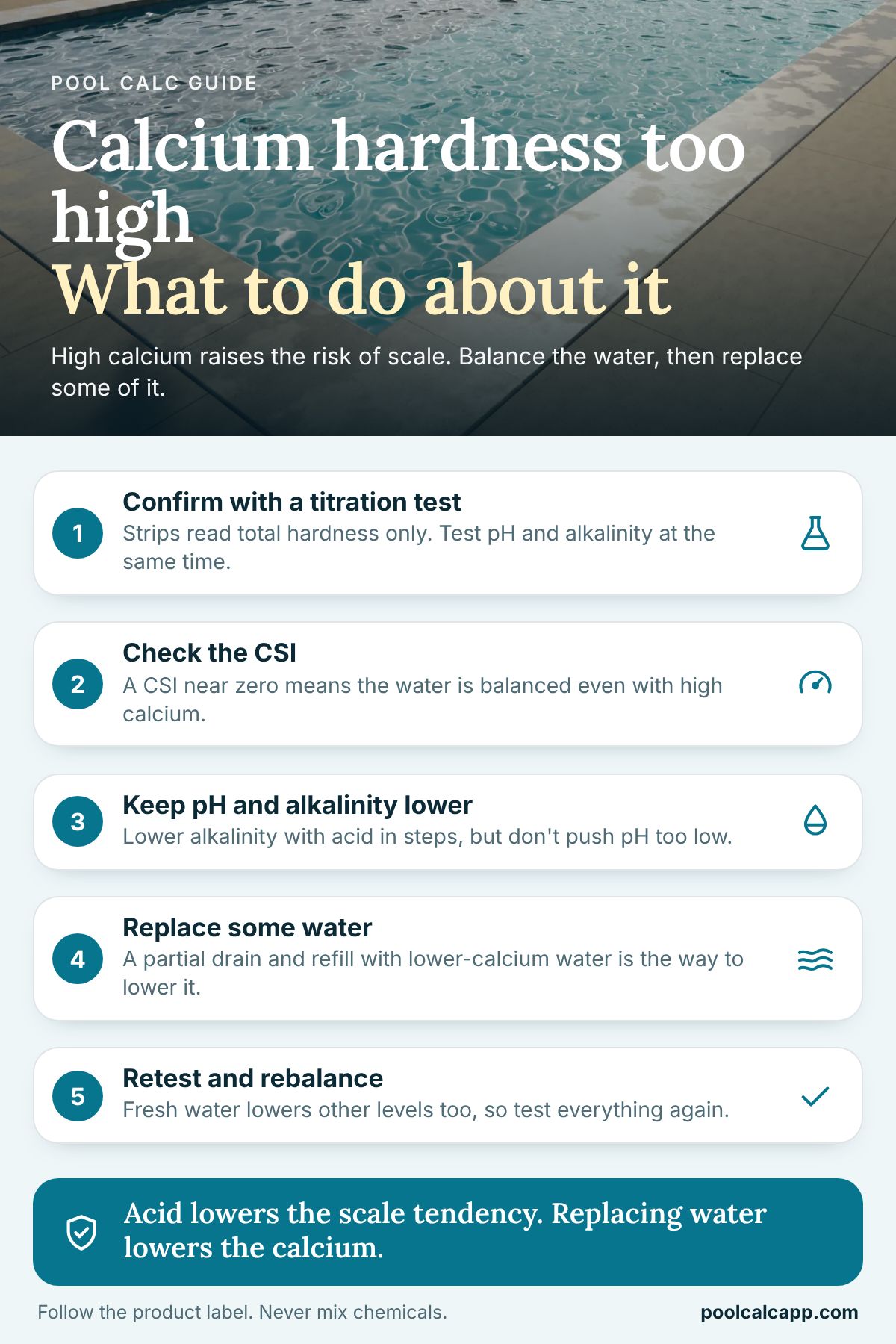
The quick answer: calcium hardness too high in a pool raises the risk of scale on the surface, in the plumbing, on a salt cell and inside a heater, and can cloud the water. The only way to lower the calcium itself is to replace some water with water that is lower in calcium, or to use reverse osmosis. Until then, keep pH and alkalinity on the low side of their ranges so the water stays balanced. Follow the product label for anything you add.
CSI / LSI calculator
−0.07
Calcite Saturation Index (CSI)
Classic LSI −0.15
Balanced.
- Aim for −0.3 to +0.3. Plaster pools do best slightly below zero to just above.
- No change needed.
| At this pH | CSI |
|---|---|
| pH 7.2 | −0.35 |
| pH 7.4 | −0.16 |
| pH 7.6 | +0.03 |
| pH 7.8 | +0.22 |
Save this test and get reminded when it is time to retest.
Want this every time you test?
Pool Calc remembers your pool and tells you what to add next time.
Pool Calc for iPhone
What high calcium hardness means
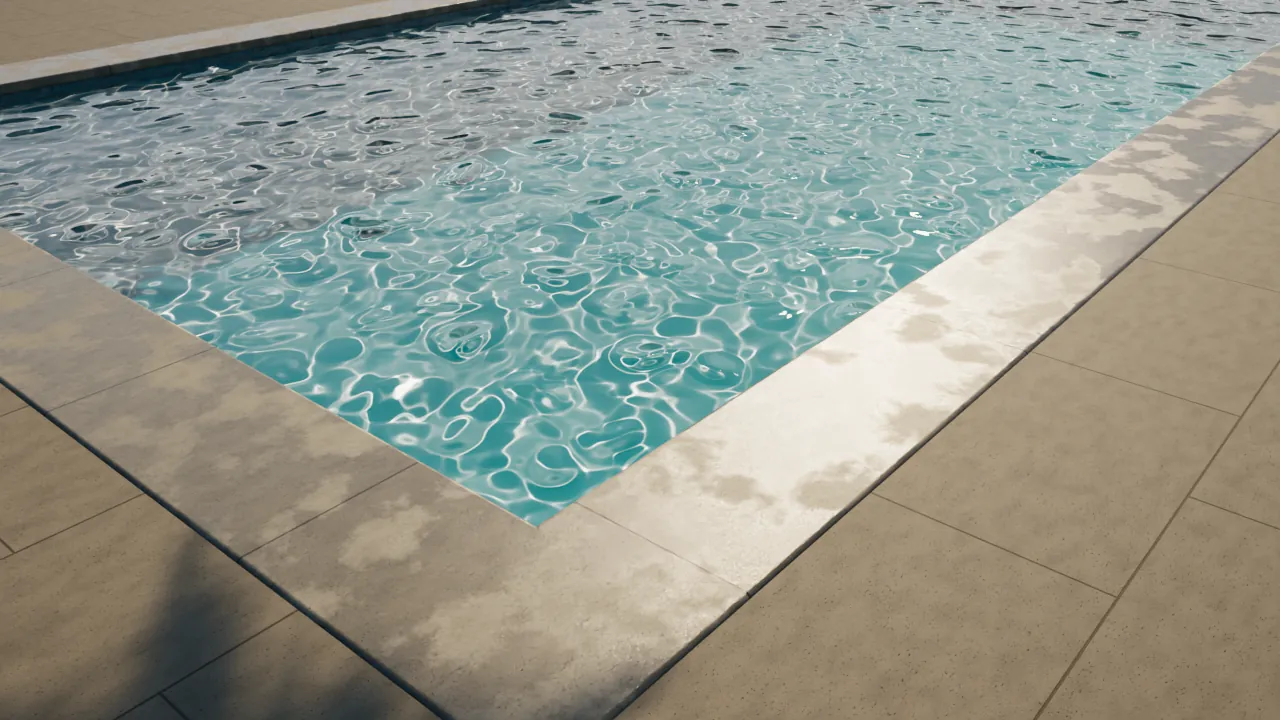
Calcium hardness (CH) is how much dissolved calcium the water holds. TroubleFreePool's Pool School says that when there is too much calcium, calcium scale can form on the pool and in the plumbing, and the water can cloud with calcium dust. Taylor Technologies describes the scale as crusty and grayish white, on surfaces, piping and equipment.
High CH on its own doesn't decide whether scale forms. CH, pH, total alkalinity and temperature together set the Calcite Saturation Index (CSI). TroubleFreePool recommends keeping the CSI between -0.3 and 0.3, and says a CSI above 0.6 brings a chance of scale. It also says pH has the largest effect on the CSI, more than calcium does. That is why a pool with high calcium can stay clear when pH and alkalinity are kept lower.
What level counts as high. TroubleFreePool's ideal levels page gives these ranges, the same for chlorine and salt pools:
| Pool surface | Ideal | Upper limit |
|---|---|---|
| Plaster or pebble | 350–550 ppm | 550–650 ppm |
| Fiberglass | 350–550 ppm | 550–650 ppm |
| Vinyl liner | 50–550 ppm | 550–650 ppm |
Other references set lower ranges: Taylor Technologies gives 200 to 400 ppm for pools. If your pool maker, plasterer or salt cell manual gives a range, follow theirs.
Why calcium hardness gets high
- Hard fill water. TroubleFreePool notes that fill water itself can carry high calcium. Every top-up adds more, and evaporation leaves the calcium behind.
- Calcium-based chlorine. Calcium hypochlorite (cal-hypo) adds calcium with every dose. The Arkansas Department of Health's pool guidelines say that using it continuously can cause high calcium and scale. If you shock with cal-hypo, how much shock to add compares it with other chlorine types.
- Overshooting a calcium increase. Calcium chloride raises CH quickly, and it doesn't come back out on its own. Our guide to calcium hardness too low covers raising it in steps.
What to do when calcium hardness is too high
Step 1: Confirm the reading. Taylor Technologies says calcium hardness is best measured with a drop-count titration test, and that test strips read total hardness only. Test pH and total alkalinity at the same time. Log all three in Pool Calc for iPhone so you can see whether CH is still rising.
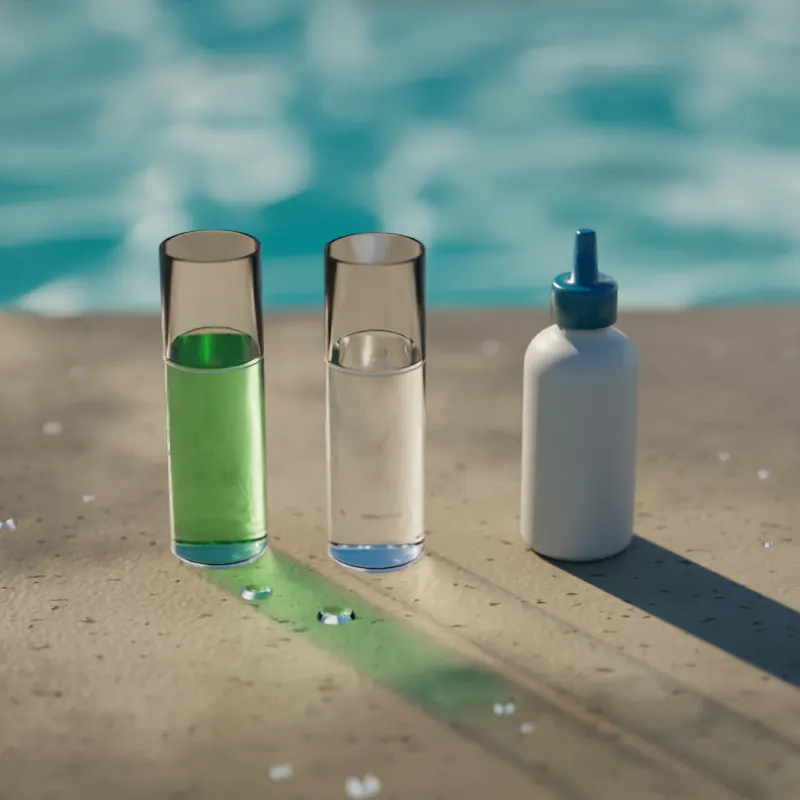
Step 2: Check the CSI. Enter CH, pH, alkalinity and water temperature in the CSI calculator above. A CSI near zero means the water is balanced even with high calcium. A high CSI means scale is likely, and you can bring it down with the next step.
Step 3: Keep pH and alkalinity lower. TroubleFreePool's Pool School says high calcium can be managed by reducing total alkalinity and keeping pH relatively low, and its salt pool guidance says the same for protecting the cell. Lower alkalinity with acid, as pool alkalinity too high explains: each 10 ppm of TA takes about 26 fl oz (758 mL) of 31.45% muriatic acid per 10,000 gallons. For pH, use the pH calculator, since the acid dose depends on your alkalinity. TroubleFreePool warns not to push pH too low, because low pH can damage copper heat exchangers. Follow the product label.
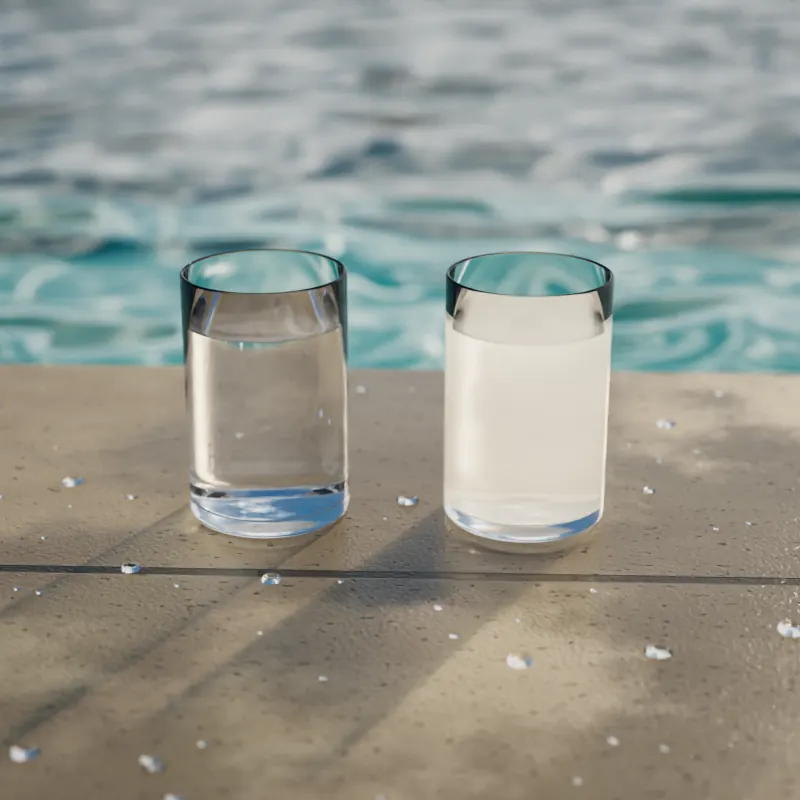
Step 4: Replace some water. TroubleFreePool's Pool School says replacing water is usually the most practical way to lower CH, and Taylor Technologies says to partially drain and refill with lower-hardness water. Test your fill water first: if it is as hard as the pool, a refill won't help, and reverse osmosis treatment is the other option. The drain and refill calculator works out how much water to swap to reach a target. Check your pool maker's instructions before lowering the water level a lot, since some pools shouldn't be drained far.
Step 5: Retest and rebalance. After the refill has mixed in, test CH, pH, alkalinity and chlorine again, and recheck the CSI. Fresh water lowers other levels too, such as stabilizer and salt, so test those as well.
Scale that is already there
TroubleFreePool's wiki says calcium scale is mostly calcium carbonate and doesn't redissolve easily at normal pool pH, so balancing the water stops new scale more than it removes old scale. Its waterline scale guide covers removing scale from tile with pumice, grit blasting or an acid product made for the job. Follow the product's label, and never use an acid product while other chemicals are in the same bucket or sprayer.
Heaters and salt cells. TroubleFreePool's wiki says very high CH can lead to thick, flaky scale inside a heater's heat exchanger, and Taylor Technologies adds that scale on heater coils slows heat transfer. TroubleFreePool's ideal levels page says high calcium can scale a salt cell. Inspect and clean the cell as its manual describes, and see pool salt level for the cell maker's ranges.
Calcium reducers
TroubleFreePool's wiki explains that calcium reducers don't remove calcium: they bind it to keep it from plating out on surfaces, and need regular doses. It calls them a stopgap in place of managing the CSI. If you use one, follow the label, and keep testing CH and CSI as usual.
Common mistakes
- Using acid to "lower calcium". Acid lowers pH and alkalinity, which lowers the scale tendency, but the calcium stays.
- Refilling with water that is just as hard. Test the fill water before you drain.
- Judging by test strips. Strips read total hardness. Use a titration test for CH.
- Pushing pH too low to fight scale. That can damage a copper heat exchanger.
- Looking at CH alone. The CSI tells you whether the water will scale. Pool Calc shows the CSI with every result, so you can see where you stand after each change.
Track it in Pool Calc
Pool Calc keeps calcium hardness, pH and alkalinity in your log, shows the CSI with each test, and works out acid doses for your pool's volume and the product strength you use. Get Pool Calc for iPhone and log your next test.
Sources
- TroubleFreePool Pool School: Calcium Scaling: too much calcium forms scale on the pool and in the plumbing and can cloud the water; pH has the largest effect on the CSI; replacing water is the practical way to lower CH; high CH can be managed with lower TA and pH; low pH can damage copper heat exchangers.
- TroubleFreePool Pool School: Calcium Saturation Index (CSI): keep the CSI between -0.3 and 0.3; above 0.6, scale may form.
- TroubleFreePool Pool School: What Are My Ideal Pool Levels?: calcium ranges by surface, the same for salt pools; high calcium can scale walls and salt cells; salt pool owners should keep pH and TA lower.
- TroubleFreePool wiki: Calcium Hardness: lower CH by replacing water or reverse osmosis; reducers bind calcium rather than remove it; very high CH can scale a heat exchanger.
- TroubleFreePool wiki: Waterline Scale Removal: scale is mostly calcium carbonate and doesn't redissolve easily; ways to remove it from tile.
- Taylor Technologies: Understanding and Managing Calcium Hardness in Pool & Spa Water: titration is the best CH test and strips read total hardness; crusty grayish-white scale; cloudy water; heater scale; partial drain and refill with lower-hardness water; pool range.
- Arkansas Department of Health: Guidelines for Pool and Spa Operators: continuous use of calcium hypochlorite can cause high calcium and scale; high hardness can cause scaling and cloudy water.
- Multnomah County Environmental Health: Water Treatment – Swimming Pools: high CH causes scale, especially in heaters and piping; partially drain to dilute the calcium.
- Every dose on this page comes from the same chemistry engine as Pool Calc.
Safety
- Keep chemicals out of reach of children and pets, and keep them out of the water until it is back in range.
- Never mix chemicals. Never add acid and chlorine together: mixing them releases toxic chlorine gas.
- Add chemicals to water, never water to chemicals.
- Store chemicals sealed, cool and dry, apart from each other.
- Read and follow the product label. It always comes first.