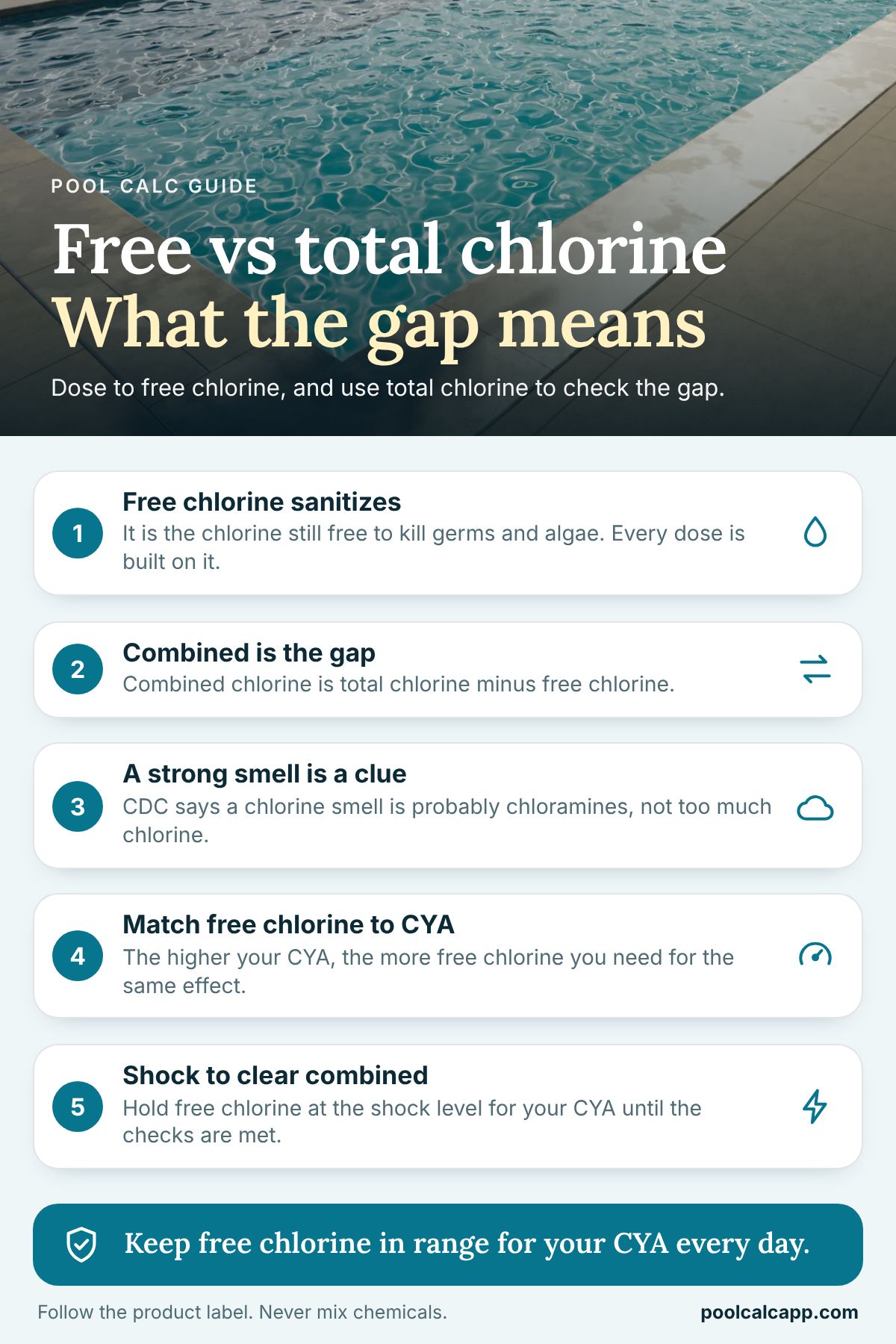
The quick answer: free chlorine (FC) is the chlorine still free to sanitize your pool. Total chlorine (TC) is free chlorine plus combined chlorine (CC), the part that has already reacted with waste. So the difference between free chlorine vs total chlorine is combined chlorine: CDC writes it as combined chlorine = total chlorine − free chlorine. Dose to free chlorine, and use total chlorine to check that combined chlorine stays near zero.
FC/CYA calculator
ppm free chlorine at CYA 40
- Manual chlorine: minimum is 7.5% of CYA; target adds a 3 ppm cushion for a sunny day.
- Shock (SLAM) is 40% of CYA, for clearing algae or combined chlorine. It is not a daily level.
Save this test and get reminded when it is time to retest.
Want this every time you test?
Pool Calc remembers your pool and tells you what to add next time.
Pool Calc for iPhone
What each reading means
- Free chlorine (FC) is hypochlorous acid and hypochlorite, the chlorine that kills germs and algae. It's the number every dose and every chart is built on.
- Combined chlorine (CC) is chlorine that has bonded with sweat, urine, dirt and other waste swimmers bring in. CDC calls these compounds chloramines. They sanitize poorly, and they're what gives a pool the sharp "chlorine" smell. CDC says that if you smell chlorine, you are probably smelling chloramines.
- Total chlorine (TC) is the two added together. On its own it can't tell you whether the chlorine in the water is doing its job.
That's why a pool can smell strongly of chlorine and still be low on free chlorine. The smell points to combined chlorine, not to too much chlorine.
How free chlorine depends on stabilizer
In an outdoor pool, stabilizer (cyanuric acid, CYA) protects chlorine from the sun. TroubleFreePool explains that the higher your CYA, the more free chlorine you need for the same effect. So "how much free chlorine" has no single answer. At CYA 30 the engine's minimum is 2.3 ppm and its target is 5.3 ppm. At CYA 50 the minimum is 3.8 ppm. The FC/CYA chart has the full table, and what is CYA in a pool explains why.
Total chlorine has no target of its own. What matters is the gap between total and free.
How to test free and total chlorine
Step 1: Test free chlorine. Taylor Technologies explains that the DPD method measures both free and total chlorine. In a DPD or FAS-DPD drop test, the sample turns pink, and the free chlorine step comes first. A FAS-DPD kit counts drops until the pink clears, which gives a precise number even at shock levels.
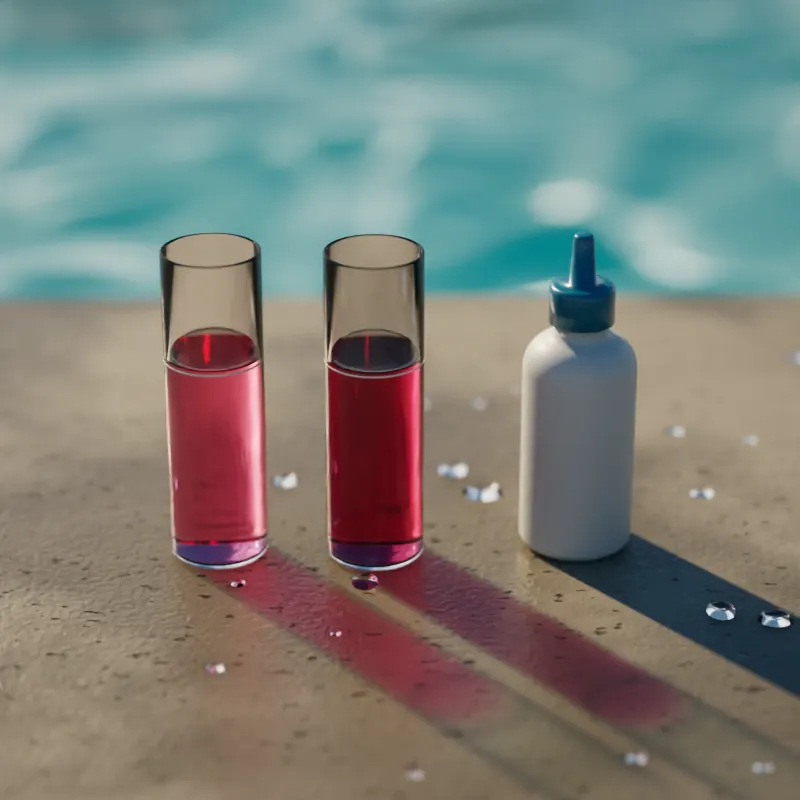
Step 2: Test total chlorine on the same sample. In Taylor's kits, an extra reagent is added for total chlorine. If the sample turns pink again, there is combined chlorine, and the extra drops measure it. Some kits report combined chlorine directly. Others give free and total, and you take one from the other.
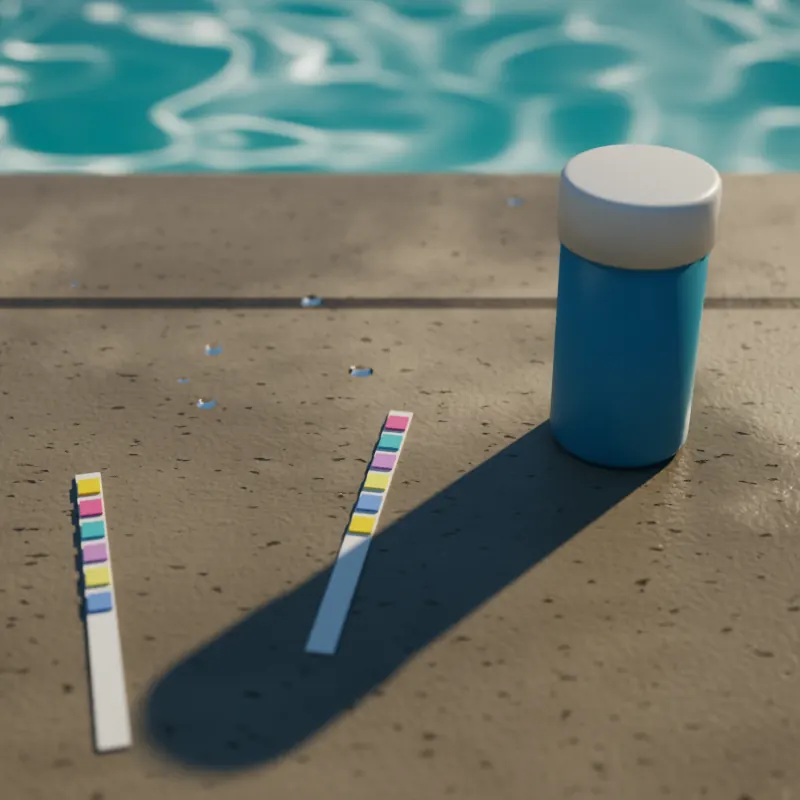
Step 3: Read test strips with care. Many strips have separate free and total chlorine pads. They're quick for a daily check, but color pads are harder to read closely than a drop count, so confirm a high combined reading with a drop kit before you act on it. Log both readings in Pool Calc for iPhone so you can see whether the gap is growing.
How much combined chlorine is too much
- CDC: most city, county and state health departments limit combined chlorine to 0.4 ppm or less. The Model Aquatic Health Code asks public pools to act when it goes above 0.4 ppm.
- TroubleFreePool: combined chlorine over 0.5 ppm indicates a problem, and it's one of the signs that a pool needs a SLAM (shock level and maintain).
Those are cited thresholds from the sources below. In a healthy outdoor pool, TroubleFreePool says combined chlorine normally stays at or near zero.
How to lower combined chlorine
Raise free chlorine to shock level and hold it there. CDC calls this superchlorination, or breakpoint chlorination. TroubleFreePool's SLAM method keeps free chlorine at the shock level for your CYA until three things are true: combined chlorine is 0.5 ppm or lower, the overnight chlorine loss is 1 ppm or less, and the water is clear. The shock level is 12 ppm at CYA 30 and 20 ppm at CYA 50.
For example, raising free chlorine from 3 ppm to 12 ppm in 10,000 gallons at CYA 30 takes about 0.9 gal (3.4 L) of 10% liquid chlorine. Household bleach is sold at 6–8.25% in the US, so use the shock calculator with the percentage on your label rather than this example. Follow the product label, add chlorine to the water with the pump running, and retest through the day.
CDC also notes that ultraviolet light or ozone systems can break down chloramines. Indoors, bring in fresh air, because chloramines off-gas into the air above the water.
When can you swim? Swim when free chlorine is back within your normal range and at or below the re-entry level on your chlorine label (many labels say 4 ppm). Never swim during a SLAM or with free chlorine above 10 ppm. Your product label always comes first. How long after shocking a pool can you swim has the detail.
Keeping the gap small
- Keep free chlorine in range for your CYA every day, not just after a problem.
- Ask swimmers to shower before swimming. CDC names pee, poop, dirt and sweat as what forms chloramines.
- Test free and total chlorine at least weekly, and after heavy use or a pool party.
- In a busy pool, top up chlorine sooner rather than waiting for the reading to sag.
Common mistakes
- Dosing to total chlorine. A high total reading can hide low free chlorine. Always dose to free chlorine.
- Treating a strong smell as "too much chlorine." CDC links that smell to chloramines. Test before you skip a dose, and see why a pool smells like chlorine for the fix.
- Ignoring stabilizer. The same free chlorine number does less work at high CYA. Check CYA before you judge your free chlorine.
- Stopping a shock too early. If combined chlorine is still above 0.5 ppm, TroubleFreePool's method keeps going. Pool Calc keeps each test in one log, so you can see when all three checks are met.
If free chlorine is fine but the water is green, see pool green but chlorine high. If it's too high to swim, see pool chlorine too high.
Track it in Pool Calc
Pool Calc sets the free chlorine range for your CYA, works out each top-up for the product you use, and tells you when you've passed the combined chlorine and overnight-loss checks. Get Pool Calc for iPhone and log your next test.
Sources
- CDC: Chloramines and Pool Operation: combined chlorine = total chlorine − free chlorine; chloramines form from swimmers' waste; most health departments limit combined chlorine to 0.4 ppm or less; superchlorination (breakpoint chlorination); UV and ozone; fresh air.
- CDC: Preventing Eye Irritation from Pool Chemicals: a chlorine smell is probably chloramines.
- CDC: Model Aquatic Health Code, 2024 (5th edition): public pools act to reduce combined chlorine above 0.4 ppm.
- Taylor Technologies: Technical FAQs: the DPD method measures free and total chlorine; the FAS-DPD drop test measures free, combined and total chlorine.
- TroubleFreePool Pool School: Pool Care Basics: combined chlorine over 0.5 ppm indicates a problem; it normally stays at or near zero outdoors; higher CYA needs more free chlorine.
- TroubleFreePool Pool School: SLAM, Shock Level and Maintain: the three checks that end a SLAM.
- Every dose and level on this page comes from the same chemistry engine as Pool Calc.
Safety
- Keep chemicals out of reach of children and pets, and keep them out of the water until it is back in range.
- Never mix chemicals. Never add acid and chlorine together: mixing them releases toxic chlorine gas.
- Add chemicals to water, never water to chemicals.
- Store chemicals sealed, cool and dry, apart from each other.
- Read and follow the product label. It always comes first.