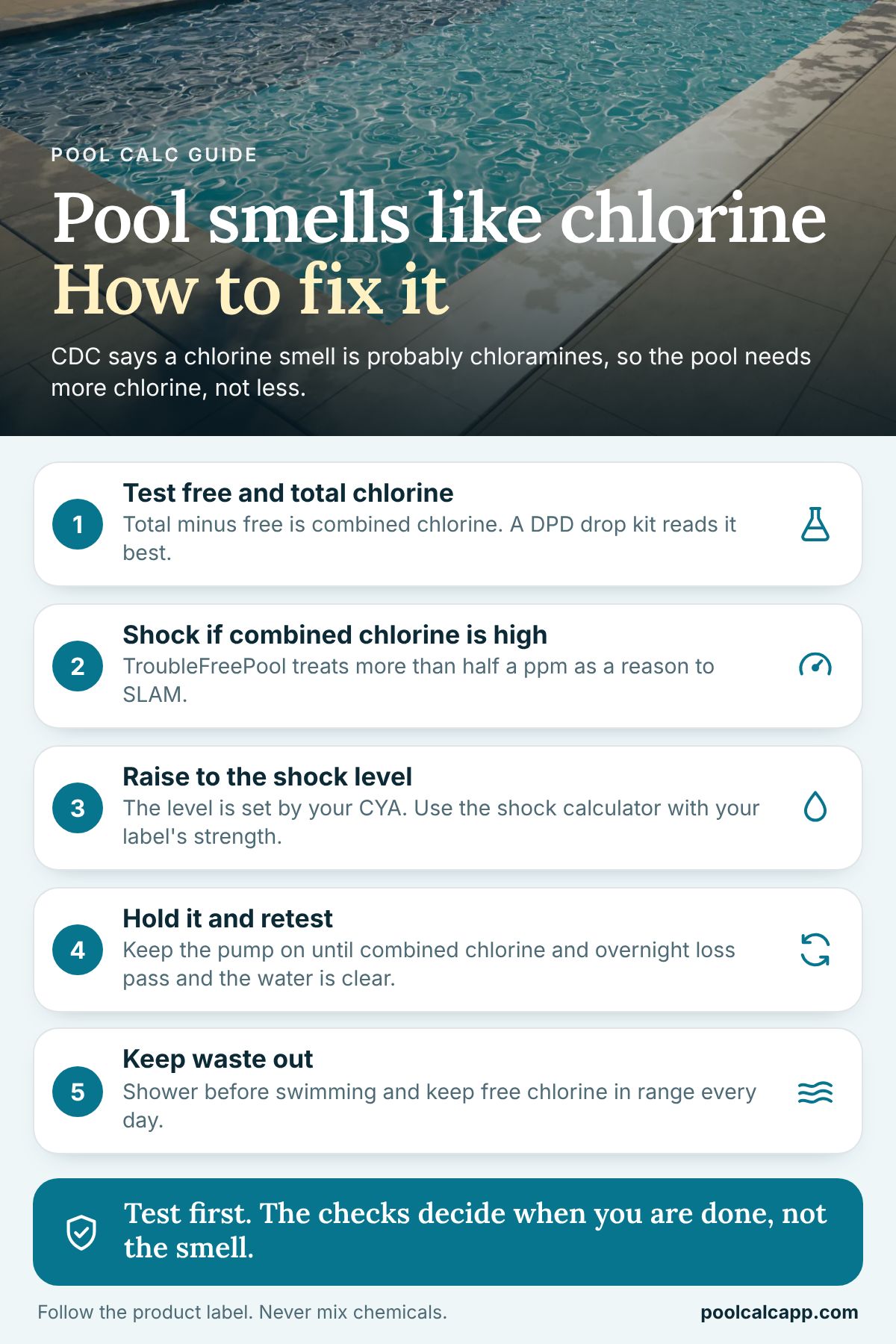
The quick answer: if your pool smells like chlorine, it usually needs more chlorine, not less. CDC says a "chlorine" smell at a pool is probably chloramines, a kind of combined chlorine that forms when chlorine reacts with sweat, pee and dirt. Test free and total chlorine, and if combined chlorine is above about 0.5 ppm, raise free chlorine to shock level until it's gone. At CYA 30 that shock level is 12 ppm. Follow the product label for every chemical you add.
Shock (SLAM) calculator
Add
2.1gal
of Liquid chlorine 10%
269 fl oz7.9 L
Raises free chlorine from 2 ppm to the shock level of 16 ppm (40% of CYA 40) in 15,000 gal.
- Side effects: Salt +23 ppm.
- Pour it slowly in front of a return jet with the pump running.
- Hold free chlorine at 16 ppm: retest and top up at least morning, midday and evening.
- You are done when combined chlorine is 0.5 ppm or less, the overnight chlorine loss is 1 ppm or less, and the water is clear.
- No swimming during the SLAM. Swim when free chlorine is back within your normal range and at or below the re-entry level on your chlorine label (many labels say 4 ppm). Never swim during a SLAM or with free chlorine above 10 ppm. Your product label always comes first.
Check the product label. Strengths vary by brand, so enter the % printed on yours. Add one chemical at a time, into the water, and never mix chemicals.
Save this test and get reminded when it is time to retest.
Want this every time you test?
Pool Calc remembers your pool and tells you what to add next time.
Pool Calc for iPhone
What the smell means
Chlorine kills germs, but it also reacts with what swimmers bring in. CDC lists pee, poop, sweat, dirt, skin cells, deodorant and makeup. That reaction does two things, in CDC's words: it decreases the amount of chlorine available to kill germs, and it creates chloramines. CDC adds that if you smell "chlorine" where you swim, you are probably smelling chloramines.
So the smell is a sign the chlorine is busy, and often losing. CDC's hot tub guidance puts it plainly: properly chlorinated water has little odor, and a strong chemical smell indicates a problem.
Chloramines show up on a test as combined chlorine (CC). CDC writes it as combined chlorine = total chlorine − free chlorine. Our free chlorine vs total chlorine guide explains the three readings.
Pool smells like chlorine but levels are low
This is the most common version, and it fits the chemistry. The free chlorine that reacted with waste is no longer free. What's left in the water is combined chlorine, which no longer counts toward the chlorine available to kill germs and which carries the smell. A strip or a quick test that shows low free chlorine and a strong smell is telling you the same thing twice: the pool ran short of chlorine.
Other times you may notice it:
- After shocking. CDC notes that superchlorination increases off-gassing of chloramines, so a smell during a shock is part of the process.
- In a salt water pool. A salt cell makes ordinary chlorine in the water, so chloramines form the same way.
- When the water is cloudy or green. The smell and the cloudiness often have the same cause: not enough free chlorine for the load. See cloudy pool water and pool green but chlorine high.
- Indoors. CDC explains that chloramines turn into gas and build up in the air above the water when there isn't enough fresh air.
How to fix a pool that smells like chlorine
Step 1: Test free and total chlorine. Use a DPD drop kit if you have one; CDC notes that test strips are less accurate. Subtract free from total to get combined chlorine. Test pH and stabilizer (CYA) too, because the shock level depends on CYA.
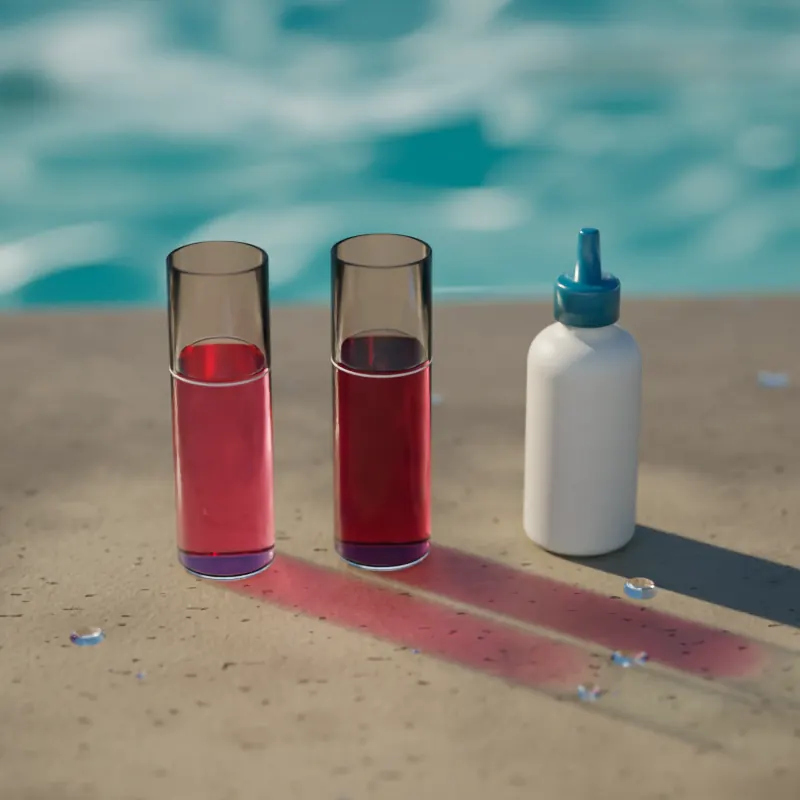
Step 2: Decide whether to shock. TroubleFreePool's Pool School treats combined chlorine above 0.5 ppm as a reason to SLAM (shock level and maintain). CDC says most health departments limit combined chlorine to 0.4 ppm or less in public pools. If combined chlorine is low and free chlorine is just below range, a normal top-up may be all you need: the FC/CYA chart shows the range for your CYA, for example a minimum of 2.3 ppm and a target of 5.3 ppm at CYA 30.
Step 3: Raise free chlorine to shock level. CDC's method for public pools is to raise free chlorine to 10 times the combined chlorine level. TroubleFreePool's SLAM uses a shock level set by CYA: 12 ppm at CYA 30 and 20 ppm at CYA 50. For example, raising free chlorine from 3 ppm to 12 ppm in 10,000 gallons takes about 0.9 gal (3.4 L) of 10% liquid chlorine. Household bleach is sold at 6–8.25% in the US, so use the shock calculator with the percentage on your label rather than this example. Follow the product label, and pour chlorine into the water with the pump running.
Step 4: Hold it there and retest. TroubleFreePool's SLAM keeps free chlorine at the shock level, testing and topping up several times a day, until all three checks pass: combined chlorine is 0.5 ppm or lower, the overnight chlorine loss is 1 ppm or less, and the water is clear. Keep the pump running. Log each test in Pool Calc for iPhone so you can see the combined chlorine falling and know when you're done.
Step 5: Let the water breathe. CDC recommends good airflow over the water while chloramines off-gas, and notes that ultraviolet light or ozone systems also break them down. For an indoor pool, bring in fresh air during and after the shock.
When can you swim? Swim when free chlorine is back within your normal range and at or below the re-entry level on your chlorine label (many labels say 4 ppm). Never swim during a SLAM or with free chlorine above 10 ppm. Your product label always comes first. How long after shocking a pool can you swim has the detail.
How to keep the smell from coming back
CDC's prevention steps all aim at keeping waste out of the water:
- Shower before swimming. CDC says even a one-minute rinse removes most of the dirt on your body.
- Use the toilet before getting in, and take kids on bathroom breaks every hour.
- Keep free chlorine in range for your CYA every day, and top up sooner after a busy swim day.
- Test free and total chlorine at least weekly, and after parties or heavy rain.
Common mistakes
- Adding less chlorine because it smells strong. That lets combined chlorine build up. Test first.
- Dosing to total chlorine. Total chlorine includes the combined part. Dose to free chlorine.
- Stopping the shock when the smell fades. The checks decide when you're done, not your nose. Pool Calc keeps every reading in one log, so it's easy to see when combined chlorine is 0.5 ppm or lower.
- Ignoring CYA. The same free chlorine reading does less at higher CYA. See what is CYA in a pool.
Track it in Pool Calc
Pool Calc works out the shock level for your CYA, sizes each top-up for the chlorine you use, and tracks the combined chlorine and overnight-loss checks. Get Pool Calc for iPhone and log your next test.
Sources
- CDC: Preventing Eye Irritation from Pool Chemicals: what forms chloramines; it decreases the chlorine available to kill germs; a "chlorine" smell is probably chloramines; showering for one minute; bathroom breaks every hour.
- CDC: Chloramines and Pool Operation: combined chlorine = total chlorine − free chlorine; most health departments limit it to 0.4 ppm or less; superchlorination raises free chlorine to 10 times combined chlorine and increases off-gassing; airflow; UV and ozone.
- CDC: What You Can Do to Stay Healthy in Hot Tubs: properly chlorinated water has little odor; a strong chemical smell indicates a problem.
- CDC: Home Pool and Hot Tub Water Treatment and Testing: DPD kits are more accurate than test strips; what reduces chlorine.
- TroubleFreePool Pool School: SLAM, Shock Level and Maintain: SLAM when combined chlorine is above 0.5 ppm; the three checks that end a SLAM; run the pump.
- Every dose and level on this page comes from the same chemistry engine as Pool Calc.
Safety
- Keep chemicals out of reach of children and pets, and keep them out of the water until it is back in range.
- Never mix chemicals. Never add acid and chlorine together: mixing them releases toxic chlorine gas.
- Add chemicals to water, never water to chemicals.
- Store chemicals sealed, cool and dry, apart from each other.
- Read and follow the product label. It always comes first.