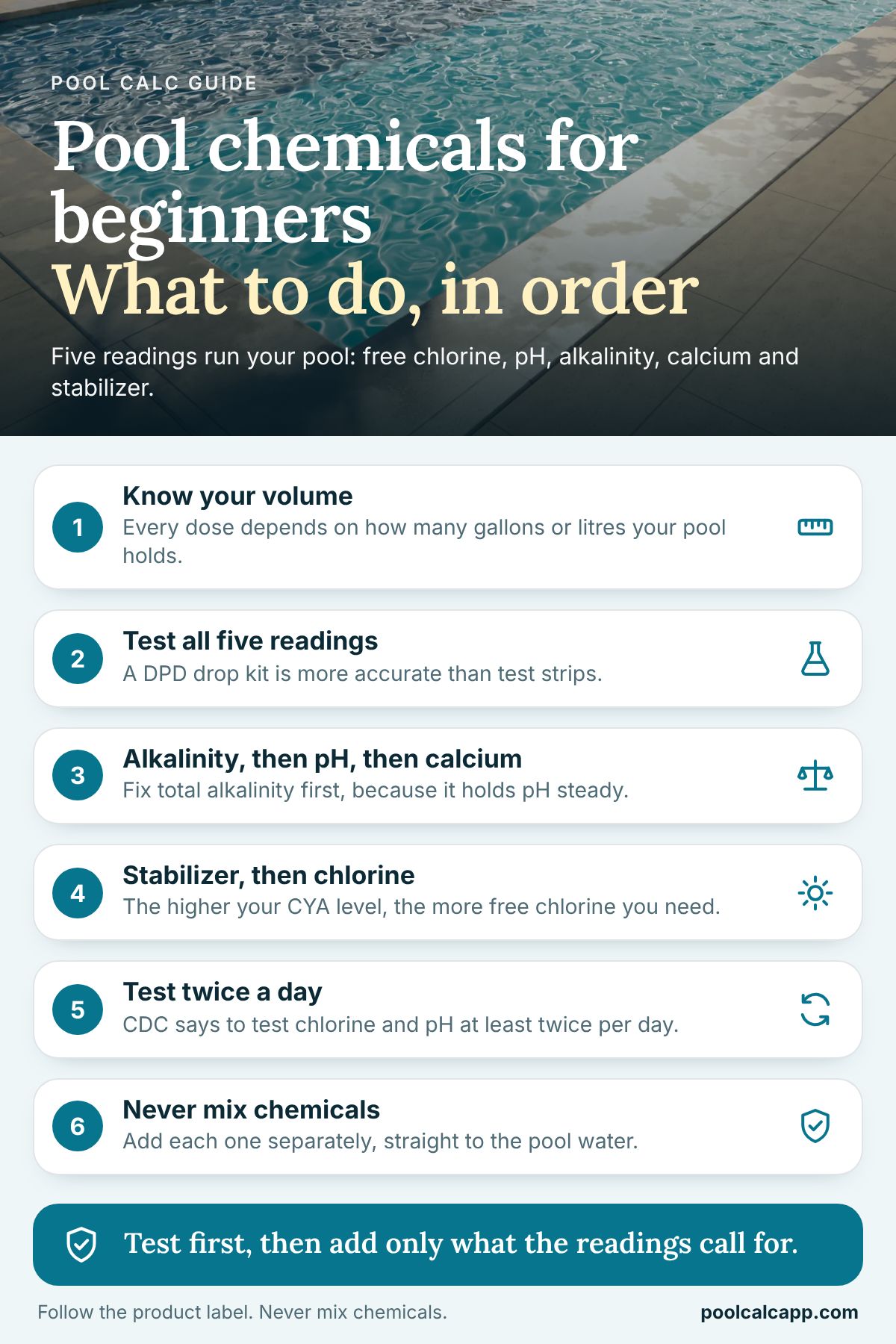
The quick answer: pool chemicals for beginners come down to five readings: free chlorine, pH, total alkalinity, calcium hardness and stabilizer (cyanuric acid, CYA). Test them first, then fix them in order, alkalinity before pH before calcium, while you keep chlorine above the minimum for your stabilizer level. At CYA 30, that minimum is 2.3 ppm of free chlorine, with a daily target of 5.3 ppm. Follow the product label for every chemical you add.
All-in-one pool calculator
Two things to fix. Start with ph.
pH 7.9 → 7.5
Lower it
Add
15fl oz
of Muriatic acid 31.45%
1.9 cups449 mL
- Side effects: TA −4 ppm.
- Never add acid and chlorine together or in the same spot: mixing them releases toxic chlorine gas. Let the first one circulate before adding the other (the wait is shown on each step).
Then wait 30 minutes with the pump running.
Free chlorine 2 ppm → 6 ppm
Raise it
Add
0.6gal
of Liquid chlorine 10%
77 fl oz2.3 L
- Side effects: Salt +6.6 ppm.
- Free chlorine is below the minimum for your stabilizer level.
In range
- CH 300 ppm
- CYA 40 ppm
- TA 80 ppm
Water balance (CSI +0.32): Scale forming: calcium can come out as scale or cloudy water.
Check the product label. Strengths vary by brand, so enter the % printed on yours. Add one chemical at a time, into the water, and never mix chemicals.
Save this test and get reminded when it is time to retest.
Want this every time you test?
Pool Calc remembers your pool and tells you what to add next time.
Pool Calc for iPhone
The five readings and what each one does
TroubleFreePool's Pool School sums up the job of each reading in one line. In plain words:
| Reading | What it does | Raise it with | Lower it with |
|---|---|---|---|
| Free chlorine (FC) | Kills germs and keeps algae away | Liquid chlorine, tablets, a salt cell | Time and sunlight |
| pH | Keeps water comfortable and protects equipment | Soda ash | Muriatic acid or dry acid |
| Total alkalinity (TA) | Holds pH steady | Baking soda | Acid, then aeration |
| Calcium hardness (CH) | Protects plaster and fiberglass | Calcium chloride | Replacing some water |
| Stabilizer (CYA) | Shields chlorine from sunlight | Stabilizer granules | Replacing some water |
CDC asks for at least 1 ppm of chlorine in pools, or at least 2 ppm when the pool uses cyanuric acid, and a pH of 7.0 to 7.8. For alkalinity, Pool School suggests 50 to 90 ppm and Taylor Technologies lists 80 to 120 ppm as ideal. For calcium, Pool School puts plaster and fiberglass pools at 250 to 650 ppm, and Taylor gives 200 to 400 ppm; vinyl pools need little or none. Your pool maker's range comes first.
Why chlorine depends on stabilizer
This is the one idea most beginner lists leave out. Stabilizer protects chlorine from the sun, but it also holds most of that chlorine in reserve, so the more CYA in the water, the more free chlorine you need. TroubleFreePool's Pool School says it directly: the higher your CYA level, the more FC you need.
| Stabilizer (CYA) | Minimum FC | Daily target |
|---|---|---|
| 30 ppm | 2.3 | 5.3 |
| 40 ppm | 3 | 6 |
| 50 ppm | 3.8 | 6.8 |
All values are ppm free chlorine, from the same engine as Pool Calc. The FC/CYA chart has every level, and what is CYA in a pool explains the reading.
Your first week, step by step
The example below is a 10,000-gallon outdoor pool, freshly filled. Your numbers will differ, so test your own water and use the pool chemical calculator with your readings.
Step 1: Know your volume. Every dose depends on it. If you don't know it, how many gallons is my pool works it out from your pool's shape and size.
Step 2: Test all five readings. CDC recommends a DPD test kit for the most accurate results and notes that test strips are less accurate. Read free chlorine, not total; free chlorine vs total chlorine explains why. If you use strips, how to read pool test strips walks through the timing and the color chart.
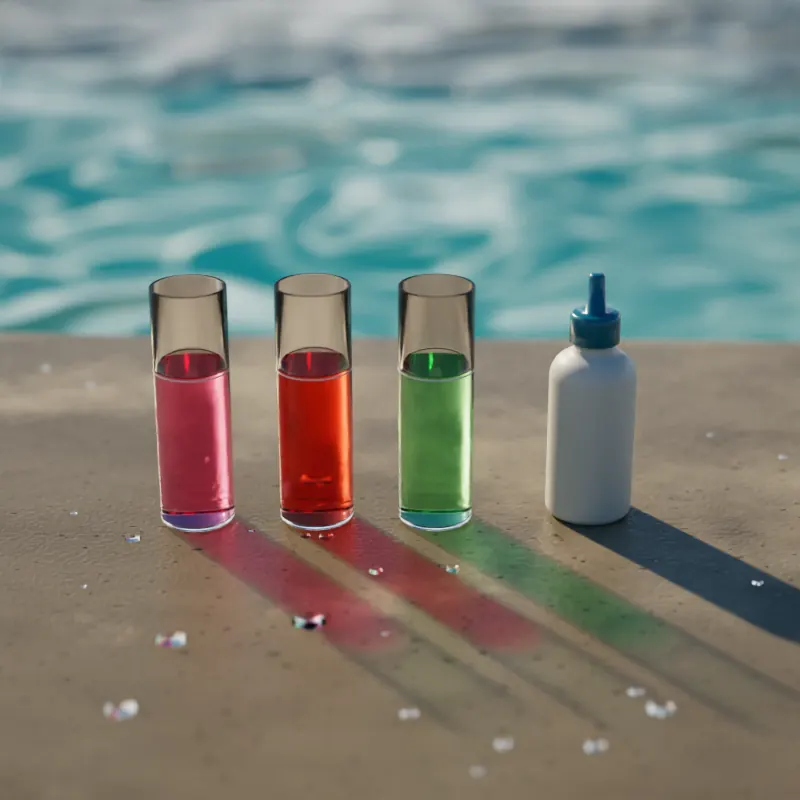
Step 3: Fix alkalinity first, then pH, then calcium. Taylor Technologies says to always treat total alkalinity first, because it controls the others; once it's in range, look at pH, then calcium hardness. For example, raising TA from 60 to 80 ppm in 10,000 gallons takes about 2.8 lb (1.3 kg) of baking soda. Lowering pH needs an acid dose that depends on your alkalinity, so use the pH calculator rather than a fixed number; pool pH too low covers the other direction. Each 10 ppm of calcium takes about 1.2 lb (545 g) of 77% calcium chloride flake. Add one chemical at a time with the pump running, and follow the product label.
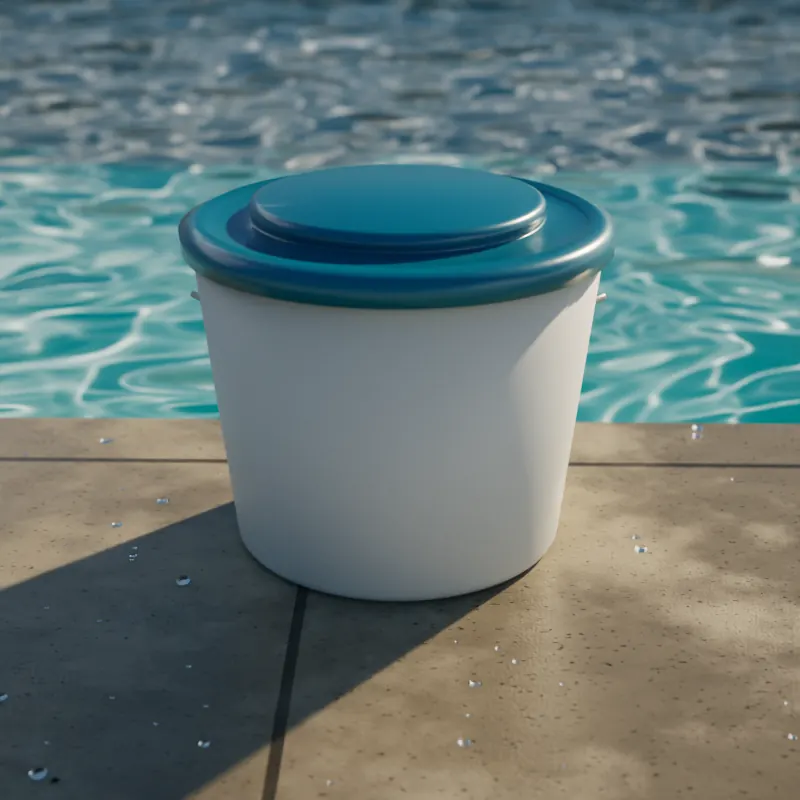
Step 4: Add stabilizer, then chlorine. In this example, raising CYA from 0 to 30 ppm takes about 2.5 lb (1.1 kg) of stabilizer granules. Then bring free chlorine up to the target for that CYA. Raising it from 0 to 5 ppm takes about 0.5 gal (1.9 L) of 10% liquid chlorine. US household bleach is sold at 6–8.25%, so use the chlorine calculator with the percentage on your own label. Follow the product label, and add chlorine to the water, never water to the chemical.
Step 5: Test again and keep a log. CDC says to test chlorine and pH at least twice per day, and more often when a number of people are using the pool. Alkalinity, calcium and stabilizer move slowly, so a weekly check is usually enough. Log every reading and dose in Pool Calc for iPhone so you can see what your pool uses from one week to the next.
What to buy first
- A good test kit. A DPD drop kit for chlorine and pH, with tests for alkalinity, calcium and CYA.
- A chlorine source. Liquid chlorine, tablets or a salt cell. Liquid chlorine vs tablets compares the first two.
- Stabilizer, for an outdoor pool.
- Baking soda to raise alkalinity, and an acid to lower pH.
- Calcium chloride, only for plaster, pebble or fiberglass pools that test low.
Skip products your readings don't call for. More chemicals don't make cleaner water.
Common mistakes
- Adding chemicals before testing. Every dose depends on a reading and your volume.
- Fixing pH before alkalinity. If TA is off, pH will keep drifting back.
- Mixing chemicals. CDC warns never to mix chlorine products with acid, because it can create toxic gases. Add each one separately, straight to the pool water.
- Using one chlorine number for every pool. Set your chlorine level by your CYA, not by a single figure from a bottle.
- Losing track of what went in. Pool Calc keeps each test and dose in one place, so you don't double-dose after a busy weekend.
Track it in Pool Calc
Pool Calc turns your five readings into doses for the products you actually own, in the order to add them, and keeps a log of every test. Get Pool Calc for iPhone and log your first test.
Sources
- CDC: Home Pool and Hot Tub Water Treatment and Testing: chlorine kills germs but not right away; at least 1 ppm chlorine in pools, at least 2 ppm with cyanuric acid; pH 7.0–7.8; test chlorine and pH at least twice per day; DPD kits are more accurate than test strips.
- CDC: Using Pool Chemicals Safely (poster for pool operators): never mix chlorine products with acid; add the pool chemical to water, never water to the chemical.
- TroubleFreePool Pool School: ABC's of Pool Water Chemistry: what FC, pH, TA, CH and CYA each do; TA 50 to 90 ppm, sometimes higher; calcium 250 to 650 ppm for plaster and fiberglass; the higher your CYA level, the more FC you need.
- Taylor Technologies: Maintain Water Balance to Protect Your Pool and Spa: treat total alkalinity first, then pH, then calcium hardness.
- Taylor Technologies: Your Pool's Total Alkalinity Explained: TA as the buffering capacity of water; 80–120 ppm ideal.
- Taylor Technologies: Calcium Hardness: 200–400 ppm in pools.
- Every level and dose on this page comes from the same chemistry engine as Pool Calc.
Safety
- Keep chemicals out of reach of children and pets, and keep them out of the water until it is back in range.
- Never mix chemicals. Never add acid and chlorine together: mixing them releases toxic chlorine gas.
- Add chemicals to water, never water to chemicals.
- Store chemicals sealed, cool and dry, apart from each other.
- Read and follow the product label. It always comes first.