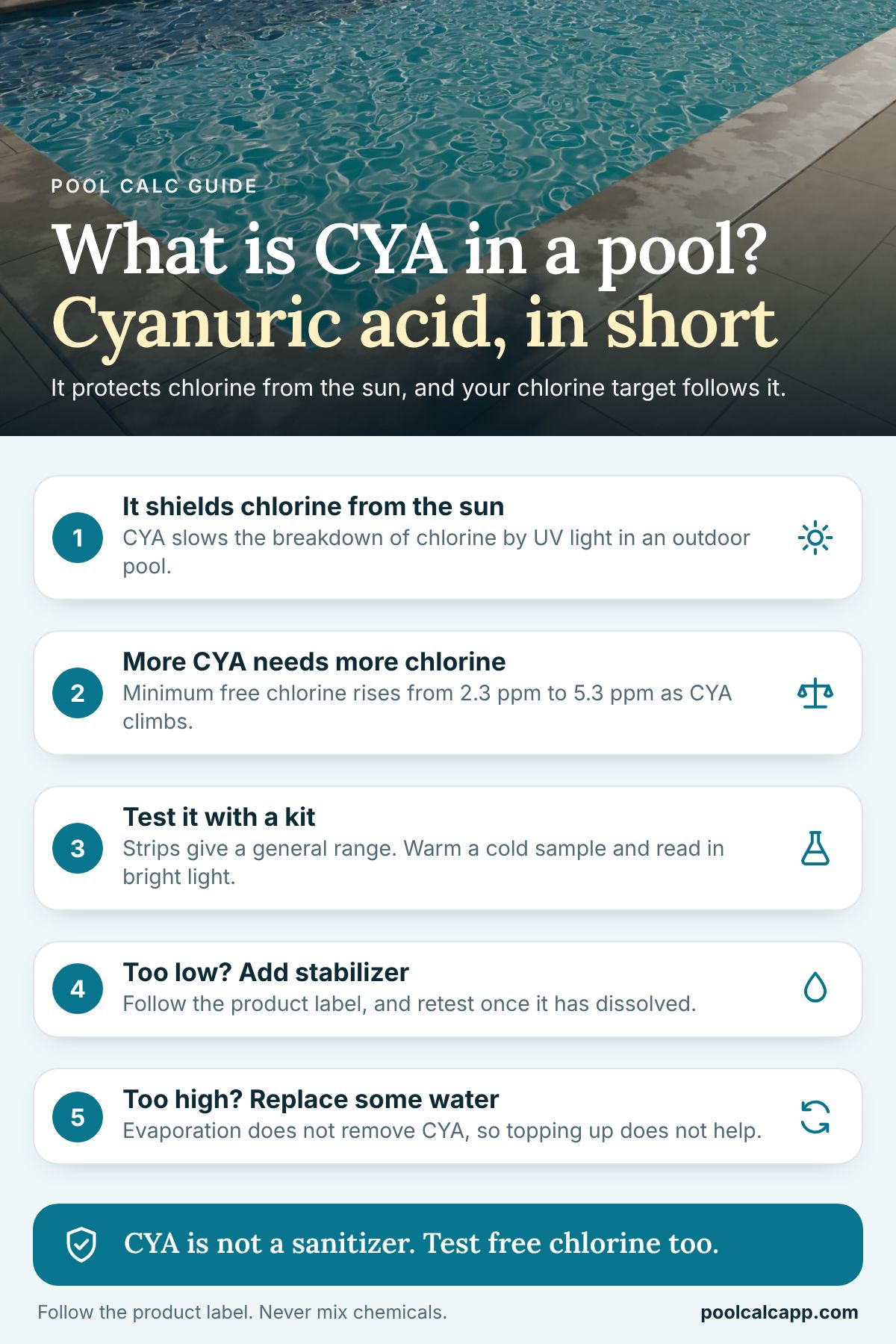
The quick answer: CYA in a pool is cyanuric acid, also called stabilizer or conditioner. It protects chlorine from sunlight, so chlorine lasts in an outdoor pool. It also holds some of that chlorine in reserve, so the more CYA you have, the more free chlorine you need. With 30 ppm CYA, the minimum free chlorine is about 2.3 ppm. With 70 ppm, it is about 5.3 ppm.
Stabilizer (CYA) calculator
Add
3.8lb
of Stabilizer granules (cyanuric acid 99%)
61 oz1.7 kg
Raises CYA from 10 ppm to 40 ppm in 15,000 gal.
- Also raises cyanuric acid (stabilizer). It only comes down by replacing water.
- Put the granules in a sock in the skimmer basket or in front of a return. Do not backwash for a week.
- Stabilizer takes several days to dissolve and register on a test. Do not add more in the meantime.
- At CYA 40 your free chlorine minimum becomes 3 ppm and the target 6 ppm.
- Adding too much is hard to undo: only draining lowers CYA. If unsure, add three quarters, wait a week and retest.
Check the product label. Strengths vary by brand, so enter the % printed on yours. Add one chemical at a time, into the water, and never mix chemicals.
Save this test and get reminded when it is time to retest.
Want this every time you test?
Pool Calc remembers your pool and tells you what to add next time.
Pool Calc for iPhone
What CYA does in pool chemistry
CYA does two jobs at once:
- It protects chlorine from the sun. Taylor Technologies explains that CYA slows the breakdown of chlorine by UV light. Without it, an outdoor pool can lose its chlorine quickly on a sunny day.
- It holds chlorine in reserve. TroubleFreePool describes CYA bonding with chlorine and releasing more as the active part gets used.
The second job is why your chlorine target follows your CYA level. CDC also notes that germs take longer to kill when CYA is in the water, and it asks for a higher chlorine minimum with CYA (2 ppm) than without it (1 ppm).
CYA isn't a sanitizer, so a good CYA reading doesn't mean the water is sanitized. You still have to test free chlorine.
What level should CYA be?
Sources differ, so check your local code if you run a public pool, and your salt cell's manual if you have one.
| Source | CYA level |
|---|---|
| PHTA ideal, quoted by Taylor Technologies | 30 to 50 ppm |
| TroubleFreePool, chlorine added by hand | 40 to 50 ppm |
| TroubleFreePool, salt pools | 70 to 80 ppm |
| Model Aquatic Health Code, limit for public pools | at or below 90 ppm |
| Texas public pool rules | 30 to 50 ppm ideal, 100 ppm maximum |
Here is what those levels mean for chlorine, from the same engine as Pool Calc for iPhone:
| CYA | Minimum free chlorine | Target free chlorine | Shock level (SLAM) |
|---|---|---|---|
| 30 | 2.3 | 5.3 | 12 |
| 40 | 3 | 6 | 16 |
| 70 | 5.3 | 8.3 | 28 |
The FC/CYA chart has every level.
Indoor pools and hot tubs are different. Indoors there is little sun for CYA to protect against. The Annex to the Model Aquatic Health Code says CDC doesn't recommend it indoors, and some states, such as Texas and Montana, prohibit it in indoor public pools. CDC also advises against CYA in hot tubs.
How to check your CYA, step by step
Step 1: Test it with a CYA test. Taylor's test mixes pool water with a reagent that turns cloudy in proportion to the CYA, then you pour the mix into a tube until a black dot disappears. Strips give a general range, and a kit gives a more exact result. TroubleFreePool advises warming a cold sample to room temperature and reading in bright light, because indoor light tends to read low.
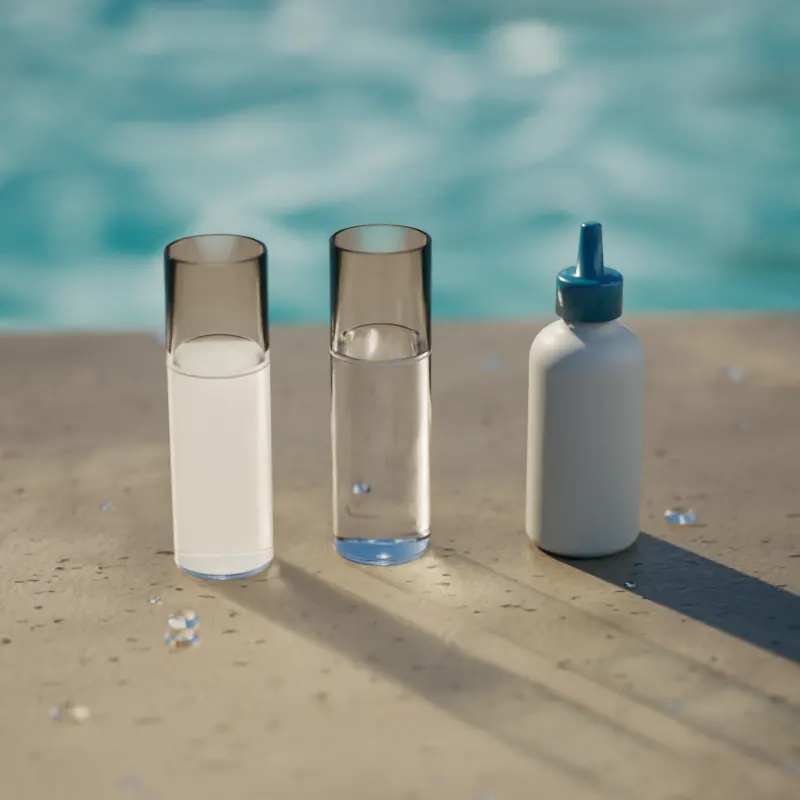
Step 2: Check a high reading by diluting it. At about 100 ppm or above, Taylor says to dilute the sample half and half with tap water, then multiply the result by 2. Do this before you drain anything.
Step 3: Look at what you add. Trichlor tablets and dichlor granules contain CYA, and hypochlorites such as liquid chlorine don't. By the same chemistry engine, 1 lb of trichlor adds about 6.5 ppm of CYA to 10,000 gallons, and 1 lb of dichlor adds about 6.1 ppm. That is why a pool on tablets creeps upward over a season.
Step 4: Log it. CYA moves slowly, so you don't need to test it as often as chlorine. Note each reading in Pool Calc for iPhone and the chlorine targets follow it.
If CYA is too low
If your outdoor pool won't hold chlorine through a sunny day, low CYA is a common cause. Raising it means adding stabilizer. To go from 20 to 40 ppm in 10,000 gallons takes about 1.7 lb (765 g) of 99% stabilizer granules, or about 202 g in 10,000 litres. Follow the product label on how to add it, and retest when the label says it has dissolved, not the same day. The stabilizer calculator works it out for your pool. If chlorine still drops, see how much liquid chlorine to add, or pool chlorine keeps dropping for the overnight loss test.
If CYA is too high
TroubleFreePool notes that evaporation doesn't remove CYA, and sunlight only breaks it down slowly. Montana's health department fact sheet gives partial draining and refilling as the fix. So high CYA doesn't go away by topping up. You either keep chlorine higher to match, or replace part of the water. Cyanuric acid too high shows how much to replace. Salt pool owners can also read pool salt level for the cell maker's ranges.
Common mistakes
- Treating CYA as a sanitizer. A good CYA reading says nothing about chlorine. Test both.
- Keeping one chlorine target at every CYA level. A target that suits 30 ppm is too low at 70 ppm.
- Using a strip to decide on a drain. Strips give a general range. Confirm with a kit first.
- Forgetting what tablets add. Pool Calc keeps your tests and doses together, so a slow rise shows up.
Track it in Pool Calc
Pool Calc sets your chlorine target from your CYA reading, sizes each dose for your pool and product, and keeps your tests in one log. Get Pool Calc for iPhone and enter your next CYA test.
Sources
- Taylor Technologies: Why Monitoring Cyanuric Acid (CYA) in a Pool Is Important: what CYA does; which chlorines contain it; how the test works.
- Taylor Technologies: Technical FAQs: PHTA ideal range.
- Taylor Technologies: How and When to Use Dilutions: diluting high CYA readings.
- Taylor Technologies: Pool and Spa Water Testing Guide: strips and kits.
- TroubleFreePool: What Is Cyanuric Acid (CYA)?: reserve chlorine; how CYA leaves the water.
- TroubleFreePool: CYA Testing: sample temperature and lighting.
- TroubleFreePool: What Are My Ideal Pool Levels?: levels for chlorine and salt pools.
- CDC: Home Pool and Hot Tub Water Treatment and Testing: chlorine minimums with and without CYA; no CYA in hot tubs.
- CDC: Model Aquatic Health Code, 5th edition and Annex: the public pool limit; indoor pools.
- Texas DSHS: 25 TAC Chapter 265, Subchapter L: state range and indoor rule.
- Montana DPHHS: Fact Sheet on Cyanuric Acid and Stabilized Chlorine Products: partial drain and refill; indoor rule.
- Every dose and chlorine level on this page comes from the same chemistry engine as Pool Calc.
Safety
- Keep chemicals out of reach of children and pets, and keep them out of the water until it is back in range.
- Never mix chemicals. Never add acid and chlorine together: mixing them releases toxic chlorine gas.
- Add chemicals to water, never water to chemicals.
- Store chemicals sealed, cool and dry, apart from each other.
- Read and follow the product label. It always comes first.