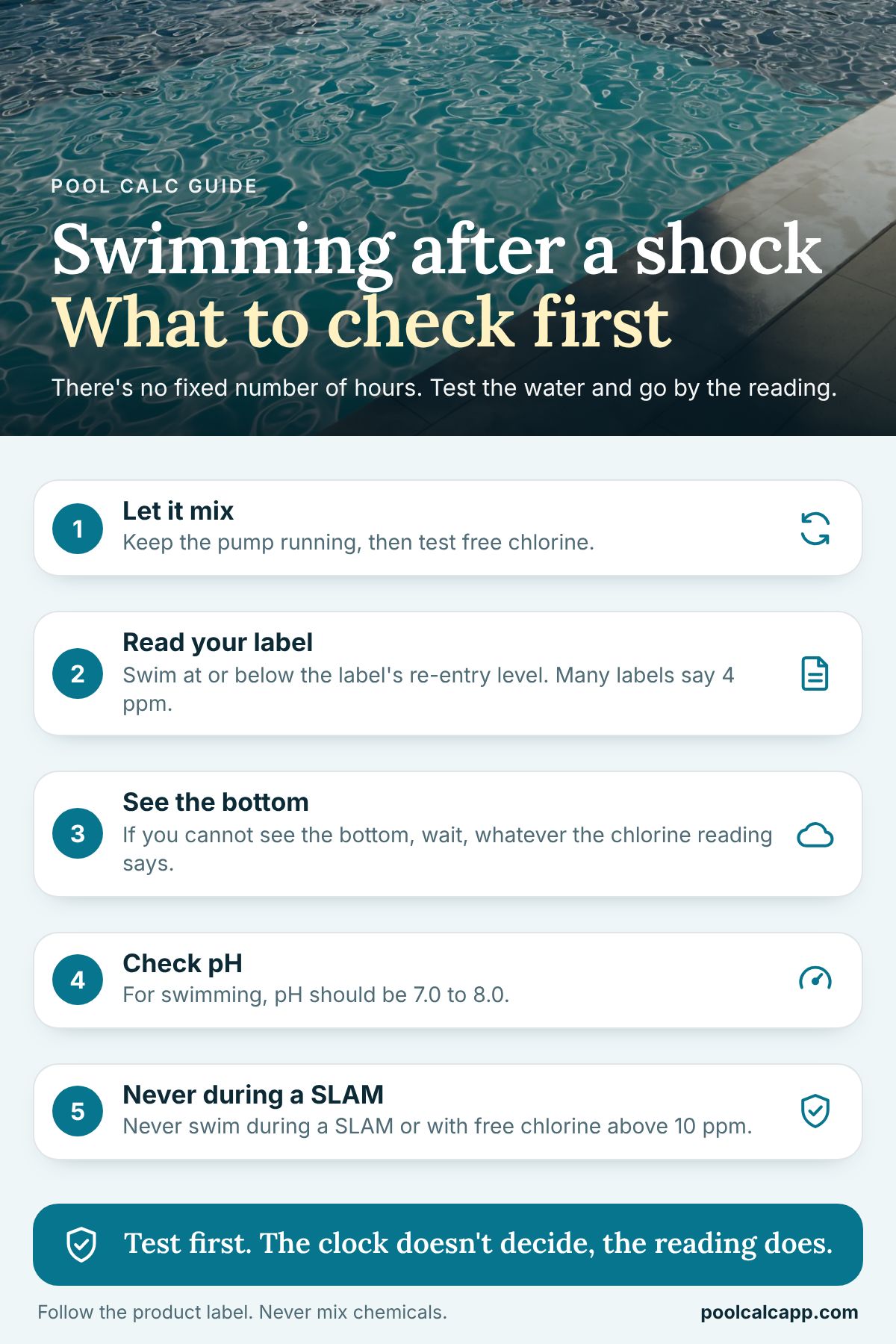
The quick answer: there's no fixed number of hours for how long after shocking a pool you can swim. Test the water, and swim when free chlorine (FC) is back in your normal range and at or below the re-entry level on your product's label. Many labels say 4 ppm. A light shock can get there within a day or two of sun; a heavy one can take several days. Follow the product label.
Shock (SLAM) calculator
Add
2.1gal
of Liquid chlorine 10%
269 fl oz7.9 L
Raises free chlorine from 2 ppm to the shock level of 16 ppm (40% of CYA 40) in 15,000 gal.
- Side effects: Salt +23 ppm.
- Pour it slowly in front of a return jet with the pump running.
- Hold free chlorine at 16 ppm: retest and top up at least morning, midday and evening.
- You are done when combined chlorine is 0.5 ppm or less, the overnight chlorine loss is 1 ppm or less, and the water is clear.
- No swimming during the SLAM. Swim when free chlorine is back within your normal range and at or below the re-entry level on your chlorine label (many labels say 4 ppm). Never swim during a SLAM or with free chlorine above 10 ppm. Your product label always comes first.
Check the product label. Strengths vary by brand, so enter the % printed on yours. Add one chemical at a time, into the water, and never mix chemicals.
Save this test and get reminded when it is time to retest.
Want this every time you test?
Pool Calc remembers your pool and tells you what to add next time.
Pool Calc for iPhone
Why the answer is a reading, not a time
How fast chlorine falls depends on how high it went, how much sun the pool gets, whether a cover is on and how much there is left for the chlorine to burn off. TroubleFreePool's Pool School says outdoor pools naturally lose about 2 to 4 ppm of free chlorine a day. A cover that blocks UV slows that loss.
So the same shock dose can clear in a day in one pool and take most of a week in another. That's why the labels we checked don't give a wait in hours. They give a chlorine reading:
| Registered product label | What it says about getting back in |
|---|---|
| Sodium hypochlorite 12.5% | "Do not reenter pool with a chlorine level above 4 ppm" |
| Calcium hypochlorite shock | After a shock, don't reenter until the residual is 1 to 4 ppm |
| Calcium hypochlorite 67% | Reentry is prohibited above 3 ppm |
These are examples, not recommendations for a product. Your own label comes first, and as you can see, it may be stricter than the number on someone else's.
When to swim after shocking: step by step
Step 1: Let it mix, then test free chlorine. Keep the pump running. One registered cal-hypo label says to run the circulation system for at least 1 hour and then recheck the residual. Above 10 ppm, CDC notes that a DPD test can partly or fully bleach out and read falsely low or zero.
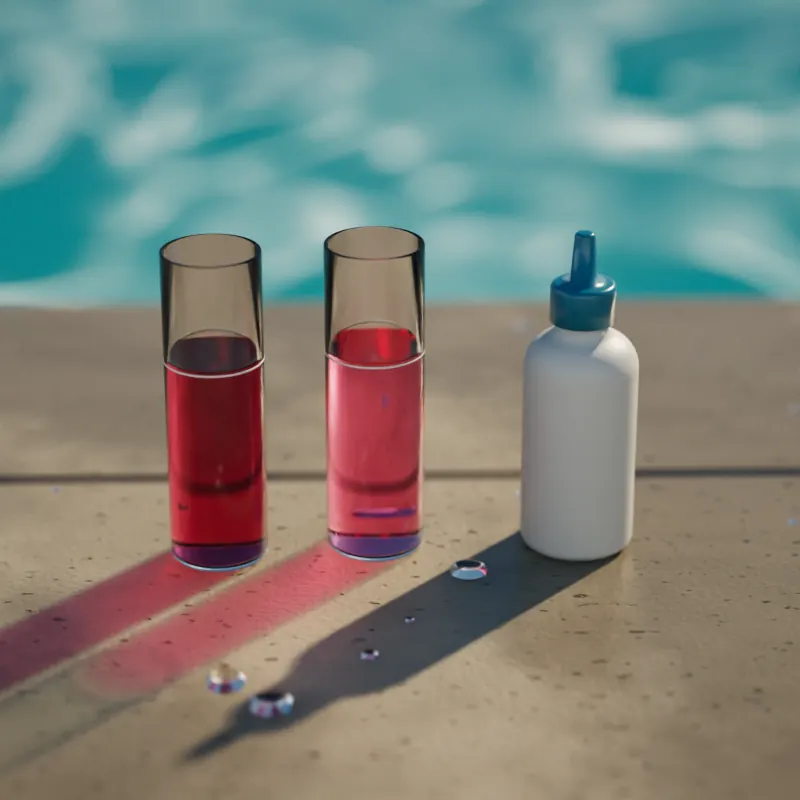
Step 2: Compare the reading with your label. Find the re-entry level on the product you used. If it isn't clear, use 4 ppm until you can check. It shouldn't have fallen too far, either. The minimum depends on your stabilizer (CYA): about 2.3 ppm at 30 ppm CYA, and 3.8 ppm at 50 ppm CYA. The FC/CYA chart has the rest.
Step 3: Check you can see the bottom. A shock can leave the water hazy while the filter catches up. The Washington State Department of Health puts it plainly: if you cannot see the bottom, you will not be able to see a person either. Wait until the water is clear, whatever the chlorine reading says. Cloudy pool after shock covers what to do if it stays that way.
Step 4: Check pH, then swim. For swimming, pH should be 7.0 to 8.0. Taylor Technologies notes that chlorine above about 10 ppm can turn the pH test blue or purple, so take this reading once chlorine has come down. Log it all in Pool Calc for iPhone, and it reminds you when to retest.
How long it usually takes, by type of shock
A normal chlorine shock. Using TroubleFreePool's 2 to 4 ppm a day, a pool a few ppm over its target is usually back in range within a day or two of sun. Higher readings take longer, and cloudy days or a cover stretch it out. If you overshot, see pool chlorine too high.
A SLAM (shock level and maintain). A SLAM holds FC at 40% of your CYA, such as 12 ppm at 30 CYA or 20 ppm at 50 CYA, until the algae is gone. That can last days. Then it takes more days for the level to fall.
Swim when free chlorine is back within your normal range and at or below the re-entry level on your chlorine label (many labels say 4 ppm). Never swim during a SLAM or with free chlorine above 10 ppm. Your product label always comes first.
TroubleFreePool's guide is more relaxed about swimming during a SLAM as long as you can see the bottom. We go with the chlorine labels, which set a re-entry limit far below SLAM level.
Non-chlorine shock (MPS). It isn't chlorine, so a free chlorine reading can't tell you when it's ready. Its wait is on its own label. Follow that, and test your chlorine as usual, since MPS doesn't replace it.
If you need to swim sooner
Stop adding chlorine, take off any cover and keep the pump running in daylight. If that's still not fast enough, a chlorine reducer (sodium thiosulfate) can bring FC down. Use a small amount, follow the product label and retest, because it's easy to overshoot. Don't use one in the middle of a SLAM: the high level is what's doing the work.
What about other chemicals after a shock?
Each product's label sets its own wait, so read it before adding a clarifier or an algaecide. Hold off on adding anything until you've tested, and don't add two products at once. Never mix chlorine and acid, and add each one separately to the pool water, as the label says.
If you're adjusting pH or alkalinity as well, the pH calculator works out the dose for your water.
For how big a shock to give in the first place, see how much shock to add to a pool. Hot tubs have different limits: see hot tub shock: how long to wait.
Common mistakes
- Going by the clock. "Wait 24 hours" is a habit, not a rule from any label we checked. Test first.
- Testing right after pouring. The chlorine hasn't mixed yet, so the reading can be far off in either direction.
- Trusting a test that bleached out. Right after a big shock, a low or zero DPD reading can really mean very high chlorine.
- Swimming in hazy water because the chlorine looks right. Clear water is part of the check.
- Forgetting when you shocked. Pool Calc keeps each dose and test in one log, so you know what went in and when.
Track it in Pool Calc
Pool Calc sizes the shock for your pool and stabilizer level, keeps your tests and doses in one log, and shows when to retest. Get Pool Calc for iPhone and log your next shock.
Sources
- EPA label: sodium hypochlorite solution 12.5%: "Do not reenter pool with a chlorine level above 4 ppm".
- EPA label: HTH Pool Shock: do not reenter until the chlorine residual is 1 to 4 ppm.
- EPA label: calcium hypochlorite 67%: reentry prohibited above 3 ppm; run circulation for at least 1 hour, then recheck.
- TroubleFreePool Pool School: SLAM, Shock Level And Maintain: end checks; brush and vacuum daily; a week or more for the filter to clear the water; its view on swimming during a SLAM.
- TroubleFreePool Pool School: Free Chlorine: outdoor pools lose 2 to 4 ppm of FC a day; UV-blocking covers lower the loss.
- CDC: Home Pool and Hot Tub Water Treatment and Testing: above 10 ppm a DPD test can bleach out and read falsely low.
- Taylor Technologies: Why Am I Getting Unusual Test Results?: chlorine over about 10 ppm turns phenol red blue or purple.
- Washington State Department of Health: Water Clarity (DOH 333-146): if you cannot see the bottom, you will not see a person either.
- Every other number on this page comes from the same chemistry engine as Pool Calc.
Safety
- Keep chemicals out of reach of children and pets, and keep them out of the water until it is back in range.
- Never mix chemicals. Never add acid and chlorine together: mixing them releases toxic chlorine gas.
- Add chemicals to water, never water to chemicals.
- Store chemicals sealed, cool and dry, apart from each other.
- Read and follow the product label. It always comes first.