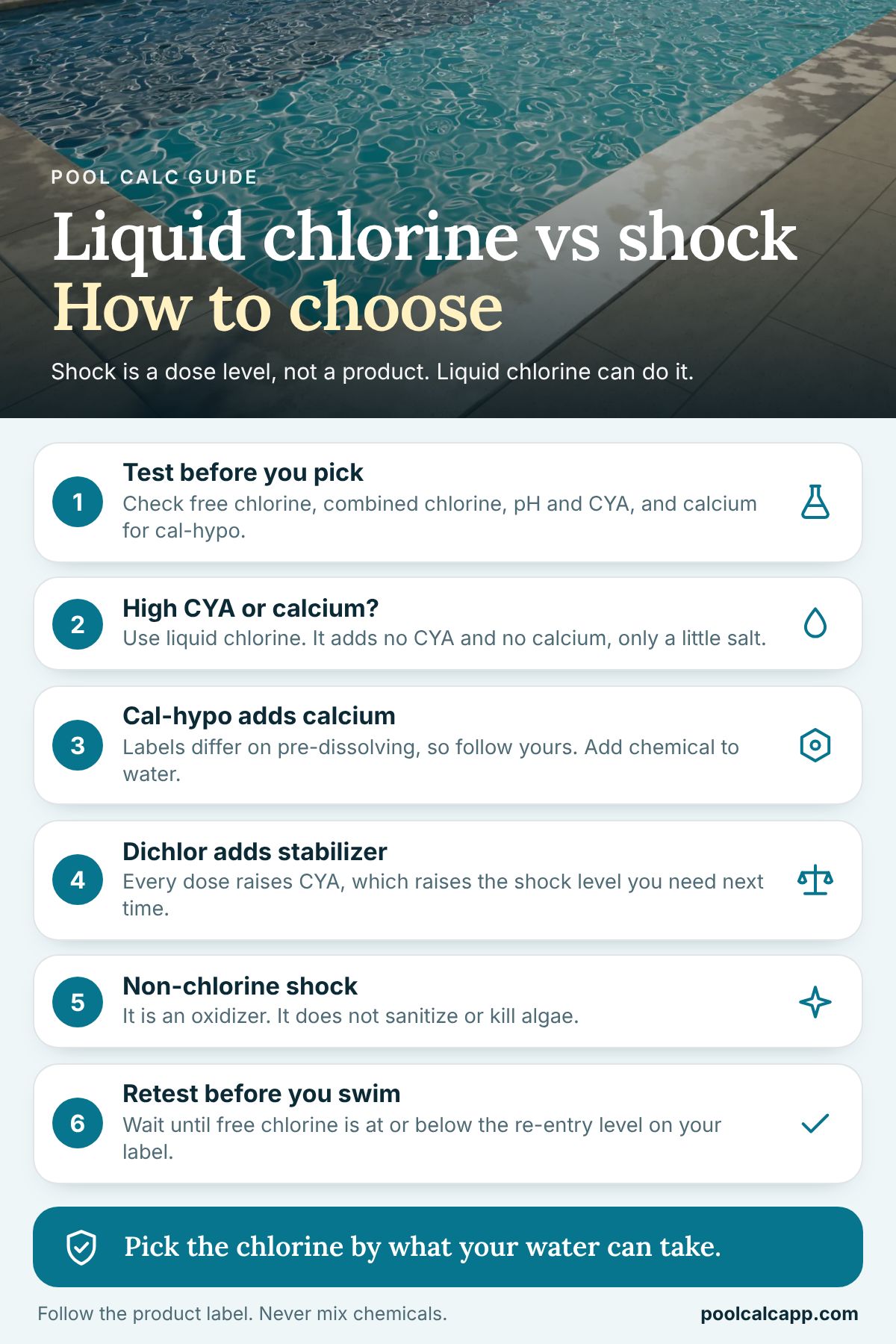
The quick answer: in the liquid chlorine vs shock question, "shock" is a dose level, not a separate chemical. Shocking means raising free chlorine (FC) well above normal for a while, and liquid chlorine can do that. The bags sold as "pool shock" are usually granular calcium hypochlorite (cal-hypo), sometimes dichlor, and the main difference is what each one leaves behind in your water. With CYA at 30 ppm, the shock level is 12 ppm, and getting there from 2 ppm in 10,000 gallons takes about 1 gal (3.8 L) of 10% liquid chlorine, or about 1.3 lb (582 g) of 65% cal-hypo.
Shock (SLAM) calculator
Add
2.1gal
of Liquid chlorine 10%
269 fl oz7.9 L
Raises free chlorine from 2 ppm to the shock level of 16 ppm (40% of CYA 40) in 15,000 gal.
- Side effects: Salt +23 ppm.
- Pour it slowly in front of a return jet with the pump running.
- Hold free chlorine at 16 ppm: retest and top up at least morning, midday and evening.
- You are done when combined chlorine is 0.5 ppm or less, the overnight chlorine loss is 1 ppm or less, and the water is clear.
- No swimming during the SLAM. Swim when free chlorine is back within your normal range and at or below the re-entry level on your chlorine label (many labels say 4 ppm). Never swim during a SLAM or with free chlorine above 10 ppm. Your product label always comes first.
Check the product label. Strengths vary by brand, so enter the % printed on yours. Add one chemical at a time, into the water, and never mix chemicals.
Save this test and get reminded when it is time to retest.
Want this every time you test?
Pool Calc remembers your pool and tells you what to add next time.
Pool Calc for iPhone
What "shock" means
Local health agencies call it superchlorination or shocking: a large dose of chlorine that burns off combined chlorine (chloramines) and kills algae. It's the amount that makes it a shock, not the bottle.
TroubleFreePool's method, SLAM (Shock Level And Maintain), ties the shock level to your stabilizer (CYA) and holds it until the water passes three checks: combined chlorine at 0.5 ppm or less, an overnight chlorine loss of 1 ppm or less, and clear water. TroubleFreePool says SLAM works best with liquid chlorine only. Our how much shock to add guide walks through the full process.
The chlorine types side by side
| Product | What it is | What it adds besides chlorine |
|---|---|---|
| Liquid chlorine or bleach | Sodium hypochlorite | A little salt |
| Cal-hypo "shock" | Calcium hypochlorite granules | Calcium hardness |
| Dichlor "shock" | Stabilized chlorine granules | Stabilizer (CYA) |
| Non-chlorine shock | Potassium monopersulfate | No chlorine at all |
By the same chemistry engine as Pool Calc for iPhone, in 10,000 gallons:
- 1 lb of 65% cal-hypo adds about 5.5 ppm of calcium hardness.
- 1 lb of 56% dichlor adds about 6.1 ppm of CYA.
Neither sounds like much, but a pool needs a lot of chlorine over a season, and CYA doesn't leave the water by evaporation. That's why the choice matters more for routine dosing than for one shock.
How to choose, step by step
Step 1: Test before you pick a product. Check free chlorine, combined chlorine, pH and CYA, and calcium hardness if you are thinking about cal-hypo. Those readings tell you both the shock level and what the water can take.
Step 2: If CYA or calcium is already high, use liquid chlorine. It adds no CYA and no calcium. TroubleFreePool notes that it puts nothing in the pool except chlorine and a small amount of salt. Liquid chlorine and bleach are the same chemical, and liquid chlorine is usually stronger. If you use bleach, choose plain, unscented bleach (US household bleach is 6 to 8.25%) and enter the percentage on your label in the shock calculator. Follow the product label.
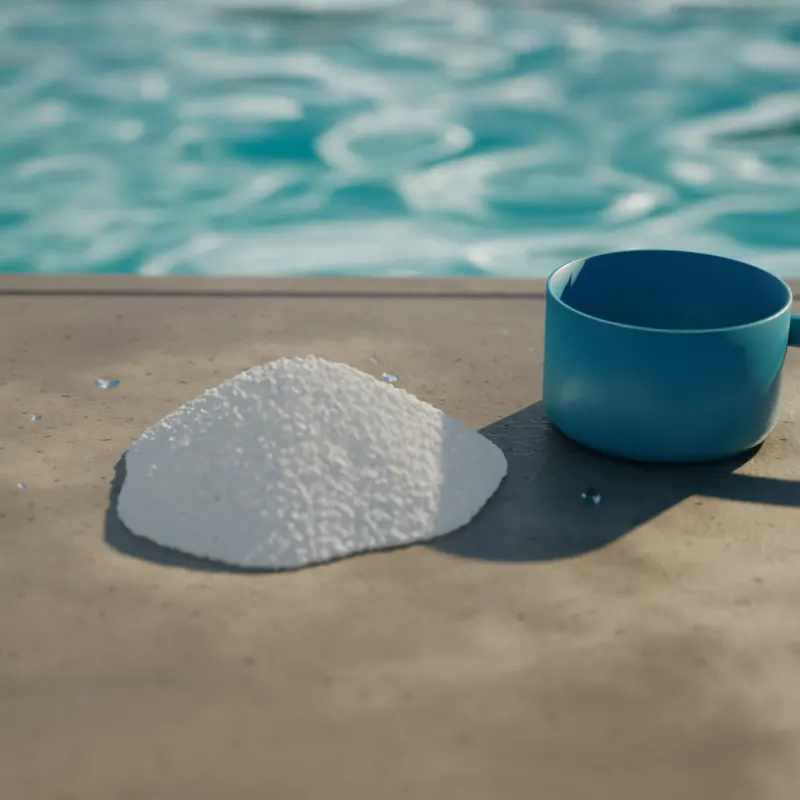
Step 3: Cal-hypo suits pools that can use the calcium. If your calcium hardness is low, cal-hypo is a reasonable shock. Labels differ on how to add it: some say to dissolve it in a plastic pail of water first, others say not to pre-dissolve it. CDC's advice is the same: pre-dissolve only when the label says so, and always add the chemical to water, never water to the chemical. Several labels say to treat at night. Follow the product label.
Step 4: Keep dichlor for small top-ups. Dichlor is sold as shock too, but every shock dose raises CYA, which raises the shock level you need next time. Trichlor tablets add CYA the same way. Our guide what is CYA in a pool explains why that matters, and liquid chlorine vs tablets compares the two for everyday chlorine.
Step 5: Don't count on non-chlorine shock for algae. Non-chlorine shock (potassium monopersulfate) is an oxidizer. Taylor Technologies says it does not sanitize or kill algae. A green or cloudy pool needs chlorine.
Step 6: Retest before you swim. After any shock, test again. Swim when free chlorine is back within your normal range and at or below the re-entry level on your chlorine label (many labels say 4 ppm). Never swim during a SLAM or with free chlorine above 10 ppm. Your product label always comes first. Log each test in Pool Calc so you can see when the level has come down.
Storage and freshness
Liquid chlorine loses strength with age, and faster in heat and sun, so a jug that has sat all summer delivers less than its label says. Buy what you will use soon and store it cool, shaded and upright. Cal-hypo is a strong oxidizer: the labels warn that mixing it with other chemicals can cause a violent reaction, fire or explosion. Store it dry, away from acids and other chlorine products, especially trichlor tablets.
Common mistakes
- Adding "one bag" no matter the CYA. The shock level rises with CYA, so a fixed dose can fall short. Use the FC/CYA chart.
- Shocking with dichlor again and again. Each dose adds stabilizer. If CYA is already high, see cyanuric acid too high.
- Mixing products or scoops. Never mix chlorine products with each other or with acid. Use a clean, dry scoop for each one.
- Swimming before you retest. Shock levels sit above the re-entry level on most labels, which is 4 ppm on many. Our guide to how long after shocking you can swim has the details.
- Losing track of the doses. Pool Calc keeps your tests and doses in one log, so you can see what each product added.
Track it in Pool Calc
Pool Calc works out the shock level from your CYA, sizes the dose for your pool and the product you have, and keeps every test in one log. Get Pool Calc for iPhone and enter your next test before you shock.
Sources
- TroubleFreePool: How to Chlorinate Your Pool: what each chlorine type adds; dichlor sold as shock; cal-hypo and calcium.
- TroubleFreePool: Pool Care Basics: liquid chlorine and bleach are the same chemical; loss of strength over time.
- TroubleFreePool: SLAM (Shock Level And Maintain): the shock level by CYA and when a shock is done; liquid chlorine for best results.
- Taylor Technologies: Monopersulfate, the Good, the Bad, and the Ugly: non-chlorine shock does not sanitize or kill algae.
- Taylor Technologies: Why Monitoring Cyanuric Acid (CYA) in a Pool Is Important: which chlorines contain CYA.
- EPA pesticide label 748-296, calcium hypochlorite 73% and EPA label 748-237, calcium hypochlorite shock: different directions on pre-dissolving; night treatment; fire and explosion warning; re-entry level.
- EPA pesticide label 8544-9, 12.5% sodium hypochlorite: loses strength with age; store away from heat and sun.
- Shasta County Environmental Health: Swimming Pool Water Chemistry Fact Sheet: superchlorination or shocking; the chlorine products used.
- CDC: Using Pool Chemicals Safely: pre-dissolve only when the label says; chemical into water; never mix chlorine products with each other or with acid.
- Every dose and chlorine level on this page comes from the same chemistry engine as Pool Calc.
Safety
- Keep chemicals out of reach of children and pets, and keep them out of the water until it is back in range.
- Never mix chemicals. Never add acid and chlorine together: mixing them releases toxic chlorine gas.
- Add chemicals to water, never water to chemicals.
- Store chemicals sealed, cool and dry, apart from each other.
- Read and follow the product label. It always comes first.