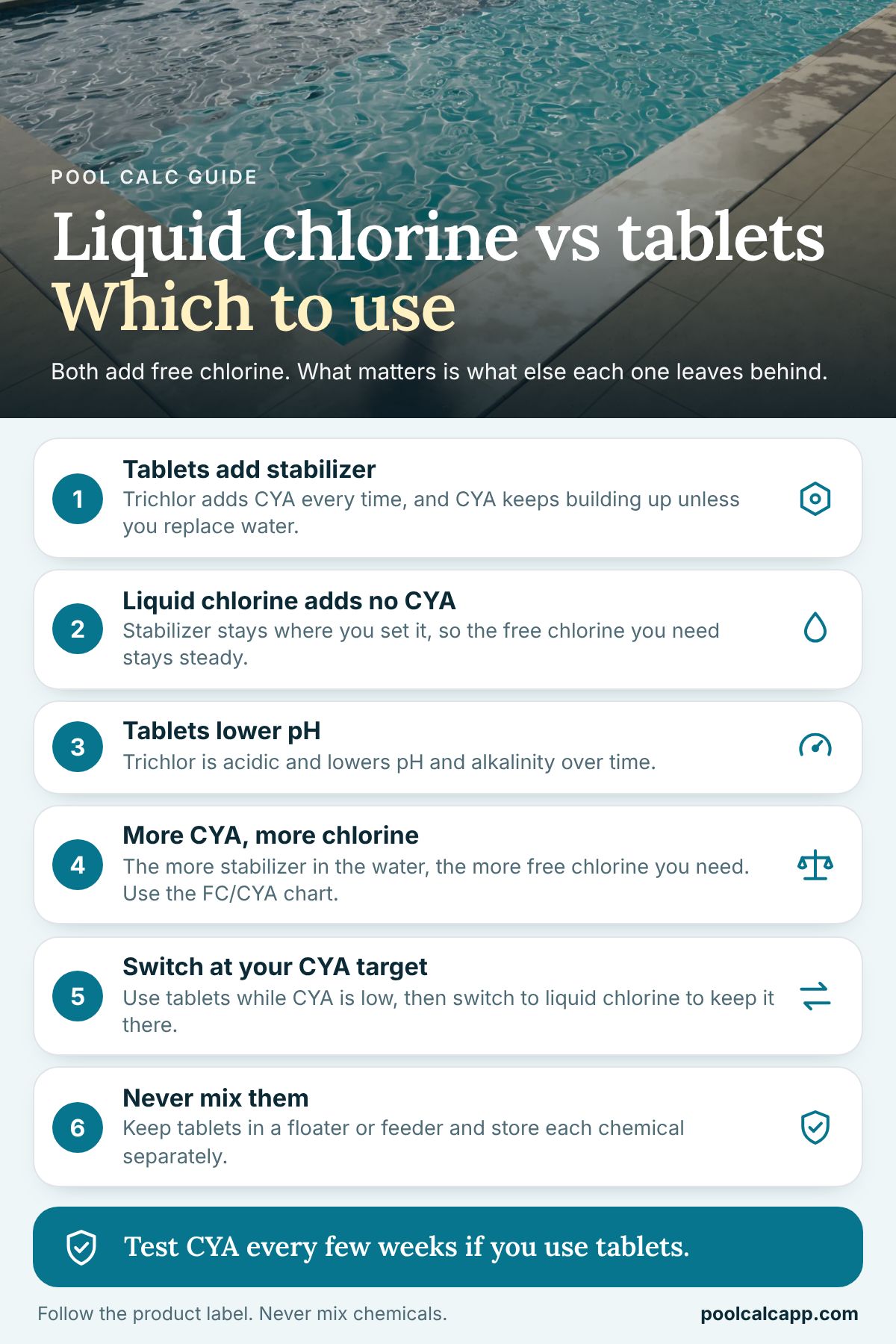
The quick answer: liquid chlorine vs tablets comes down to what else each one adds. Tablets (trichlor) add stabilizer (CYA) and acid along with chlorine, so CYA climbs all season. Liquid chlorine adds chlorine and a little salt, so CYA stays where you set it. By Pool Calc's chemistry engine, 1 lb of 90% tablets in 10,000 gallons adds about 10.8 ppm of free chlorine and about 6.5 ppm of CYA. Use tablets while CYA is low, and switch to liquid chlorine once it reaches the level you want.
Chlorine calculator
Add
0.6gal
of Liquid chlorine 10%
77 fl oz2.3 L
Raises free chlorine from 2 ppm to 6 ppm in 15,000 gal. Best added at dusk.
- Side effects: Salt +6.6 ppm.
- Pour it slowly in front of a return jet with the pump running.
Check the product label. Strengths vary by brand, so enter the % printed on yours. Add one chemical at a time, into the water, and never mix chemicals.
With CYA at 40 ppm: minimum free chlorine 3 ppm, target 6 ppm, shock level 16 ppm. FC/CYA chart
Save this test and get reminded when it is time to retest.
Want this every time you test?
Pool Calc remembers your pool and tells you what to add next time.
Pool Calc for iPhone
What each one is
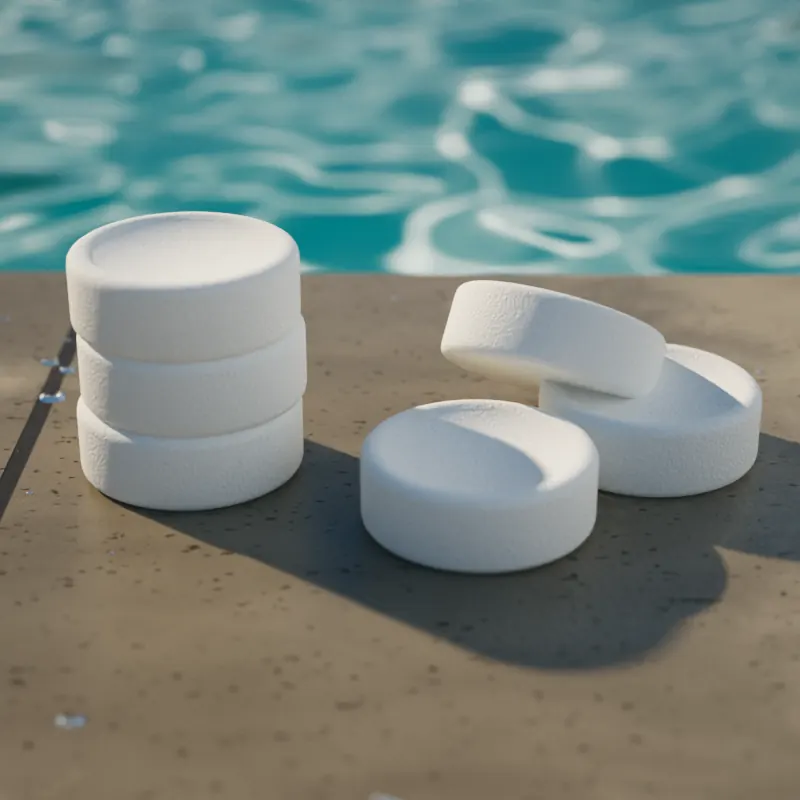
Chlorine tablets are trichlor (trichloroisocyanuric acid). TroubleFreePool's Pool School describes trichlor as essentially cyanuric acid combined with chlorine. The tablets dissolve slowly in a floater or a feeder, so they keep releasing chlorine between your visits.
Liquid chlorine is sodium hypochlorite in water, the same chemical as household bleach. TroubleFreePool lists what is in every jug: sodium hypochlorite, salt (sodium chloride), a little lye (sodium hydroxide) and water. Pool stores usually sell it at 10% or 12.5%, and US household bleach is usually 6 to 8.25%.
What each one adds to your water
This is the real difference. Both give you free chlorine, but they leave different things behind.
Step 1: Look at stabilizer (CYA). Tablets add it every time. TroubleFreePool says trichlor adds CYA, that CYA doesn't break down in normal pool water, and that it keeps building up unless you lose water to splash-out or drain and refill part of the pool. TroubleFreePool's CYA article also says evaporation doesn't remove CYA, and that replacing water is the best way to lower it. Liquid chlorine adds no CYA. What is CYA in a pool explains what stabilizer does.
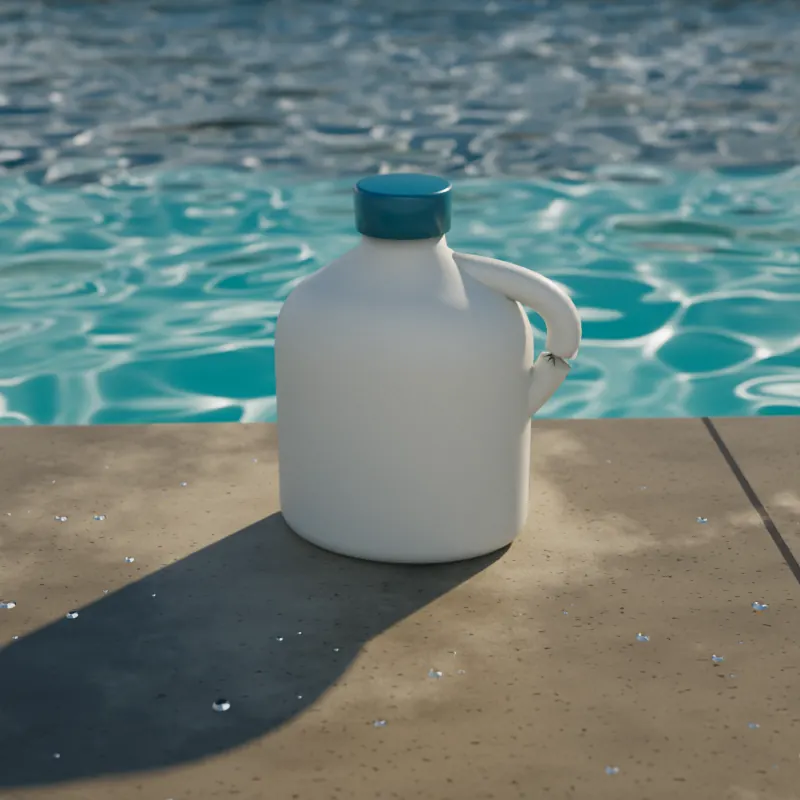
Step 2: Look at pH and alkalinity. TroubleFreePool says trichlor contains acid and will reduce pH and total alkalinity over time. Liquid chlorine raises pH a little when you add it, but TroubleFreePool explains that the net reaction is pH neutral once the chlorine is used up. So with tablets you often add something to raise pH and alkalinity; with liquid chlorine you usually don't need to for that reason.
Step 3: Look at salt. TroubleFreePool's sodium hypochlorite article says each 1 ppm of chlorine from liquid chlorine adds about 1.64 ppm of salt. That is tiny next to a salt pool's level, and it only matters over a long time.
Step 4: Look at how much chlorine you need. More CYA means you need more free chlorine. TroubleFreePool says the more stabilizer in your water, the more free chlorine you need, and CDC notes that disinfection takes longer when cyanuric acid is present. At CYA 30 the engine's target is 5.3 ppm. At CYA 80, a level tablets can reach over a season, the minimum is 6 ppm and the target is 9 ppm. The FC/CYA chart has the full table.
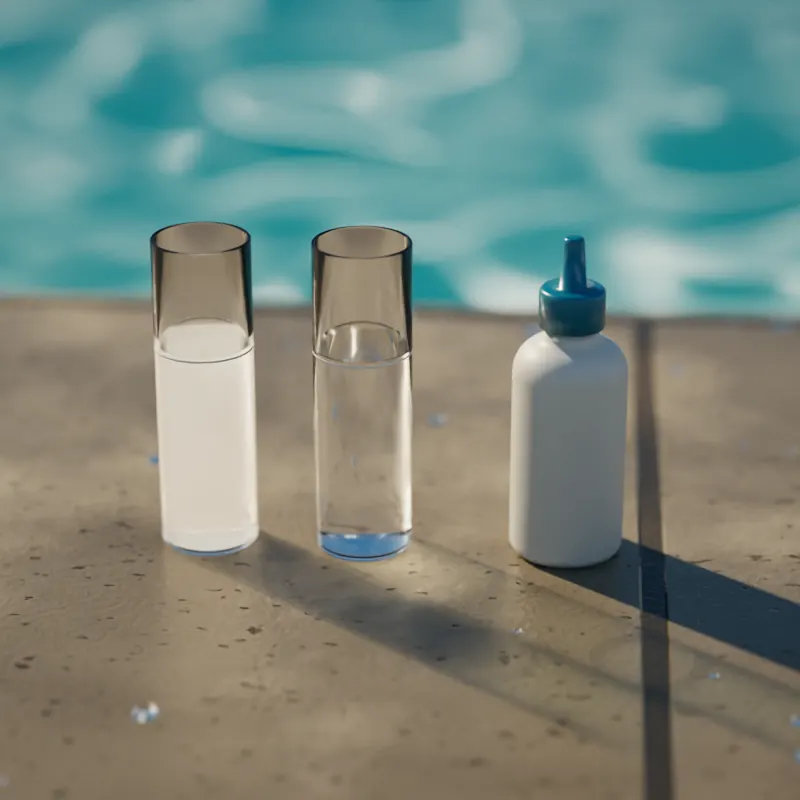
Liquid chlorine vs tablets side by side
| Tablets (trichlor) | Liquid chlorine | |
|---|---|---|
| Adds stabilizer (CYA) | Yes, every time | No |
| Effect on pH and alkalinity | Lowers both over time | About neutral once used up |
| How you add it | Floater or feeder, slowly | Poured into the water by hand |
| Storage | Dry, cool, away from other chemicals | Loses strength with heat and time |
| Best for | Low CYA, or when you are away | Keeping CYA steady |
How much for the same rise? To raise free chlorine by 1 ppm in 10,000 gallons, the engine gives about 13 fl oz (379 mL) of 10% liquid chlorine, or about 1.5 oz of trichlor. With household bleach it takes about 21 fl oz (610 mL) at 6%, or 15 fl oz (430 mL) at 8.25%. Use the chlorine calculator with the percentage on your label. Follow the product label for every product.
Prices vary by region and season, so compare the cost of the same rise for the products you can buy, not the price per jug or bucket.
How to choose
- CYA below your target: tablets are a convenient way to raise it while you chlorinate.
- CYA at your target: switch to liquid chlorine so it stays there. TroubleFreePool recommends using mainly liquid chlorine or a salt water generator.
- CYA already high: stop the tablets. Only replacing water lowers it; see cyanuric acid too high.
- Away for a while: a floater keeps adding chlorine while you're gone. Test CYA when you're back, and log it in Pool Calc for iPhone so you can see the trend over the season.
Safety when using tablets and liquid chlorine
- Never mix them. An EPA-registered trichlor tablet label says not to use or mix the product with any other chemical, such as calcium hypochlorite, because it may cause fire or explosion. CDC says pool chemicals can injure people when mixed together.
- Use tablets only in a floater or feeder. That same label says the tablets are for a floater or in-line feeder only. TroubleFreePool adds that trichlor is very acidic and should not go in the skimmer.
- Store them apart. CDC advises storing each pool chemical separately and away from heat. TroubleFreePool notes that liquid chlorine loses strength with heat and time, so buy it fresh.
Common mistakes
- Running tablets all season without testing CYA. The level keeps climbing, and so does the free chlorine you need. Test CYA every few weeks.
- Not raising free chlorine as CYA rises. A reading that was fine at CYA 30 is too low at CYA 80.
- Fighting falling pH with tablets in the floater. Trichlor is acidic. If pH and alkalinity keep dropping, the tablets are a likely cause.
- Losing track of what you added. Pool Calc logs each dose with the product used, so you can see how much CYA the tablets have added.
Track it in Pool Calc
Pool Calc works out each chlorine dose for the product you use, sets the free chlorine range for your CYA, and keeps your readings in one log, so you can see when it's time to switch from tablets to liquid chlorine. Get Pool Calc for iPhone and log your next test.
Sources
- TroubleFreePool Pool School: TriChlor: trichlor is chlorine combined with CYA; CYA builds up unless water is replaced; trichlor contains acid and lowers pH and TA; it should not be used in the skimmer; floaters and feeders.
- TroubleFreePool Pool School: What is Cyanuric Acid (CYA)?: evaporation does not remove CYA; replacing water is the best way to lower it; higher CYA needs more free chlorine.
- TroubleFreePool Pool School: Liquid Chlorine: what liquid chlorine and bleach contain; strength falls with time and temperature.
- TroubleFreePool Pool School: Sodium Hypochlorite: 1 ppm of chlorine adds 1.64 ppm of salt; heat speeds up the breakdown.
- TroubleFreePool Pool School: pH: liquid chlorine raises pH at first, but the net reaction is pH neutral.
- TroubleFreePool: Free Chlorine and Cyanuric Acid Relationship Explained: more stabilizer needs more free chlorine; mainly liquid chlorine or a salt water generator.
- EPA: trichlor 3" tablet label (EPA Reg. 46043-3): floater or in-line feeder only; do not mix with other chemicals such as calcium hypochlorite; fire or explosion risk.
- CDC: Pool Chemical Safety: chemicals can injure people when mixed; store each one separately, away from heat.
- CDC: Home Pool and Hot Tub Water Treatment and Testing: disinfection takes longer with cyanuric acid.
- Every dose and level on this page comes from the same chemistry engine as Pool Calc.
Safety
- Keep chemicals out of reach of children and pets, and keep them out of the water until it is back in range.
- Never mix chemicals. Never add acid and chlorine together: mixing them releases toxic chlorine gas.
- Add chemicals to water, never water to chemicals.
- Store chemicals sealed, cool and dry, apart from each other.
- Read and follow the product label. It always comes first.