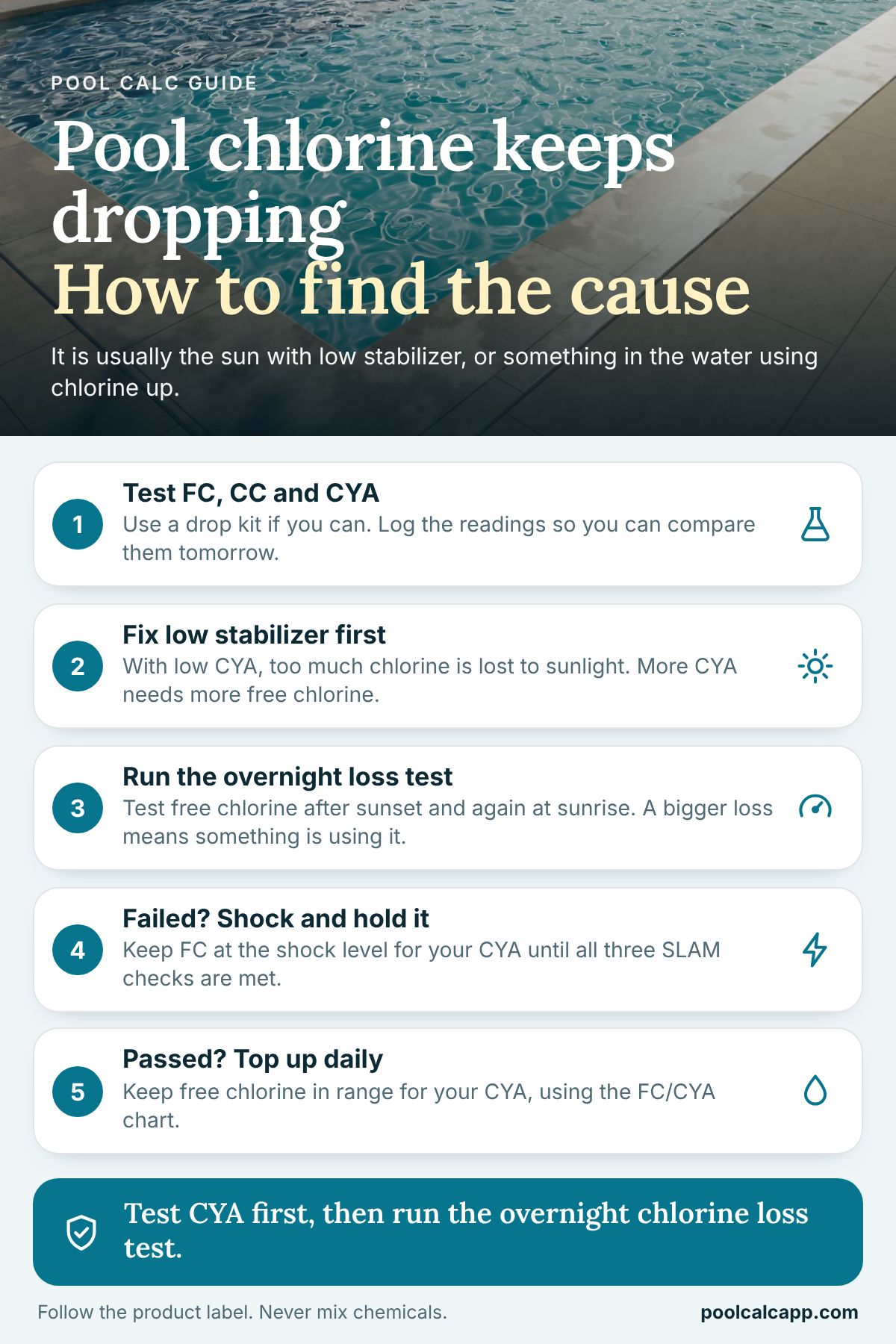
The quick answer: when your pool chlorine keeps dropping, it is almost always one of two things. Either the sun is burning it off because stabilizer (CYA) is low, or something in the water, such as algae, leaves or swimmers, is using it up. Test CYA first, then run an overnight chlorine loss test to see which one it is. At CYA 30, keep free chlorine at about 5.3 ppm and never below 2.3 ppm.
FC/CYA calculator
ppm free chlorine at CYA 40
- Manual chlorine: minimum is 7.5% of CYA; target adds a 3 ppm cushion for a sunny day.
- Shock (SLAM) is 40% of CYA, for clearing algae or combined chlorine. It is not a daily level.
Save this test and get reminded when it is time to retest.
Want this every time you test?
Pool Calc remembers your pool and tells you what to add next time.
Pool Calc for iPhone
What a dropping chlorine reading means
Some loss every day is normal. TroubleFreePool's Pool School says outdoor pools naturally lose free chlorine every day, and CDC lists sunlight and what swimmers bring in (sweat, dirt and more) among the things that reduce chlorine levels. So chlorine that falls a little between tests is expected, and you top it back up.
It becomes a problem when the reading falls faster than you can keep up, or drops below the minimum for your stabilizer before your next test. The right level is not one fixed number. TroubleFreePool explains that the free chlorine you need depends on your CYA, because stabilizer protects chlorine from sunlight but also lowers how strong it is. The FC/CYA chart has the full table.
Why pool chlorine keeps dropping
- Low stabilizer. TroubleFreePool's SLAM article says that below 30 ppm CYA "you lose too much chlorine to sunlight." A new fill or a large refill can leave CYA low. What is CYA in a pool explains what it does.
- Algae starting to grow. Algae uses chlorine before you can see it. TroubleFreePool notes that algae grows faster in warmer water.
- Organic material. TroubleFreePool lists swimmers' waste, pollen and leaves as things that consume free chlorine. A busy weekend or a windy day can use up a lot.
- Heavy use. CDC lists what swimmers bring in among the things that reduce chlorine, and advises testing more often when a pool is used by a number of people.
- Combined chlorine building up. If total chlorine is well above free chlorine, chlorine is busy reacting with contaminants. Free chlorine vs total chlorine explains how to read the gap.
How to fix it, step by step
Step 1: Test free chlorine, combined chlorine and CYA. Use a drop kit if you can, since CDC notes that test strips are less accurate. Write the readings down, or log them in Pool Calc for iPhone so you can compare them with tomorrow's.
Step 2: Fix low stabilizer first. If CYA is under 30, the sun is likely taking much of your chlorine. Raise CYA with stabilizer, following the product label. As a guide, going from CYA 10 to 30 in 10,000 gallons takes about 1.7 lb (765 g) of stabilizer granules. Work out your own amount with the stabilizer calculator, and remember that more CYA means you need more free chlorine.
Step 3: Run an overnight chlorine loss test. TroubleFreePool's method is to test free chlorine after sunset, then again at sunrise, with no chlorine added in between. With no sun overnight, any loss is chlorine being used by something in the water. A loss of 1 ppm or less passes.
Step 4: If the test fails, shock and hold it. A loss of more than 1 ppm overnight usually means algae or other organic material. TroubleFreePool's SLAM method raises free chlorine to the shock level for your CYA and keeps it there until combined chlorine is 0.5 ppm or lower, the overnight loss is 1 ppm or less, and the water is clear. The shock level is 12 ppm at CYA 30 and 20 ppm at CYA 50. If the water is already turning green, see green pool water: how to fix it.
Step 5: If the test passes, top up and keep it in range. A pass means the sun is the main cause, so daily top-ups are normal. For example, raising free chlorine from 2 to 5 ppm in 10,000 gallons takes about 0.3 gal (1.1 L) of 10% liquid chlorine. US household bleach is sold at 6–8.25%, so use the chlorine calculator with the percentage on your label. Follow the product label, and add chlorine to the water with the pump running.
When can you swim? Test again after the steps above. Swim when free chlorine is back within your normal range and at or below the re-entry level on your chlorine label (many labels say 4 ppm). Never swim during a SLAM or with free chlorine above 10 ppm. Your product label always comes first.
How to keep chlorine from dropping
- Keep CYA at a level that suits your pool and keep free chlorine in range for it, using the FC/CYA chart.
- Test free chlorine often, and more often after heavy use, rain or a hot spell.
- Skim leaves and debris, and keep the filter running and clean.
- Use how much liquid chlorine to add to size your daily top-up.
Common mistakes
- Adding more and more chlorine without testing CYA. With very low stabilizer, much of each dose is lost to the sun the same day.
- Raising CYA without raising free chlorine. CDC notes that disinfection takes longer when cyanuric acid is in the water, so a higher CYA needs a higher free chlorine level.
- Stopping a shock too early. If the overnight loss is still above 1 ppm, there is still something to burn off. Pool Calc keeps each reading in one log, so you can see when all three SLAM checks are met.
- Trusting one strip reading. Confirm a surprising result with a drop kit before you act on it.
Track it in Pool Calc
Pool Calc sets the free chlorine range for your CYA, works out each top-up for the product you use, and keeps your readings in one log, so a dropping trend shows up early. Get Pool Calc for iPhone and log your next test.
Sources
- TroubleFreePool Pool School: Free Chlorine: outdoor pools lose free chlorine every day; UV light destroys chlorine; swimmers' waste, pollen, leaves and algae consume it; algae grows faster in warmer water; the FC needed depends on CYA.
- TroubleFreePool Pool School: SLAM, Shock Level and Maintain: below 30 ppm CYA too much chlorine is lost to sunlight; the overnight test at sunset and sunrise; the three checks that end a SLAM, including an overnight loss of 1 ppm or less.
- TroubleFreePool Pool School: ABC's of Pool Water Chemistry: CYA protects chlorine from sunlight and sets the required FC level; FC is consumed by sunlight and organic material.
- CDC: Home Pool and Hot Tub Water Treatment and Testing: sunlight and what swimmers bring in reduce chlorine levels; test more often with more swimmers; disinfection takes longer with cyanuric acid; test strips are less accurate than drop kits.
- Every dose and level on this page comes from the same chemistry engine as Pool Calc.
Safety
- Keep chemicals out of reach of children and pets, and keep them out of the water until it is back in range.
- Never mix chemicals. Never add acid and chlorine together: mixing them releases toxic chlorine gas.
- Add chemicals to water, never water to chemicals.
- Store chemicals sealed, cool and dry, apart from each other.
- Read and follow the product label. It always comes first.