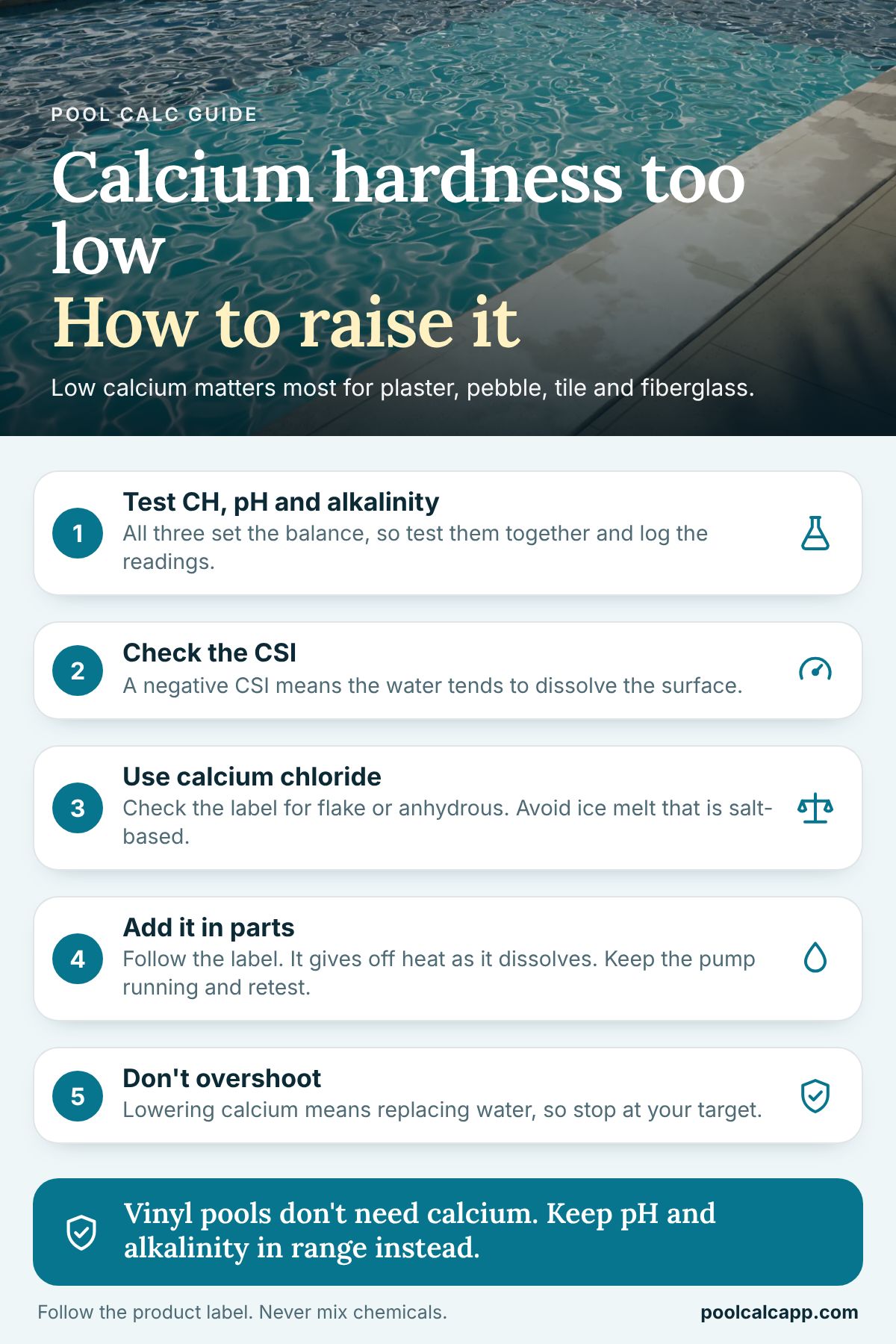
The quick answer: calcium hardness too low in a pool matters most for plaster, pebble, tile and fiberglass, because water short on calcium takes it from the surface. TroubleFreePool's Pool School puts the ideal for plaster and fiberglass at 350 to 550 ppm. Raise it with calcium chloride: each 10 ppm takes about 1.2 lb (545 g) of 77% flake per 10,000 gallons. Vinyl pools don't need calcium. Follow the product label.
Calcium hardness calculator
Add
36lb
of Calcium chloride flake 77%
577 oz16 kg
Raises calcium hardness from 150 ppm to 350 ppm in 15,000 gal. Recommended for this surface: 250 to 450 ppm.
Add it in 2 parts
- Add 18 lb.
- Wait 60 minutes with the pump running, retest, then add 18 lb if you still need it.
- This is a large change. Add it in stages and retest between them.
- Dissolve it in a bucket of pool water first, then pour it in front of a return jet.
- Calcium chloride gets hot when it dissolves. Add it to a bucket of water, never water onto the flakes.
Check the product label. Strengths vary by brand, so enter the % printed on yours. Add one chemical at a time, into the water, and never mix chemicals.
Save this test and get reminded when it is time to retest.
Want this every time you test?
Pool Calc remembers your pool and tells you what to add next time.
Pool Calc for iPhone
What low calcium hardness means
Calcium hardness (CH) is how much dissolved calcium the water holds. TroubleFreePool's Pool School says water low in calcium tends to dissolve calcium out of plaster, pebble, tile, stone and concrete, and to some extent fiberglass. Over time that can rough up and etch a plaster finish.
CH is one part of the water's balance. TroubleFreePool's wiki explains that CH feeds the Calcite Saturation Index (CSI), which shows how saturated the water is with calcium carbonate. A negative CSI means the water tends to dissolve the surface. Low pH and low alkalinity push it the same way, so check all three together in the CSI calculator.
What level to aim for. TroubleFreePool's ideal levels page gives these ranges:
| Pool surface | Acceptable low end | Ideal |
|---|---|---|
| Plaster or pebble | 250–350 ppm | 350–550 ppm |
| Fiberglass | 250–350 ppm | 350–550 ppm |
| Vinyl liner | 0–50 ppm | 50–550 ppm |
TroubleFreePool's wiki adds that calcium helps fiberglass pools resist staining and cobalt spotting. If your pool maker or plasterer gives a range, follow theirs.
Why calcium hardness gets low
- Soft fill water. Your source water sets the starting level. A new fill, a big refill or replacing water after a drain starts at whatever your tap or well water carries.
- Refills after a drain. Replacing water to fix something else, such as high stabilizer, brings CH down toward your fill water's level too.
If you're not sure what your fill water carries, test a sample from the hose the same way you test the pool.
How to raise calcium hardness, step by step
Step 1: Test calcium, pH and alkalinity. Use a test kit that reads CH, and test pH and total alkalinity at the same time, since all three set the balance. Log the readings in Pool Calc for iPhone so you can see the trend over time.
Step 2: Check the balance. Enter your readings in the CSI calculator. If pH or alkalinity is low too, fix those as well: pool alkalinity too low and pool pH too low walk through each. Raise one thing at a time and retest between them.
Step 3: Work out the calcium chloride. TroubleFreePool's Pool School says calcium hardness is raised with calcium chloride or calcium chloride dihydrate. Products come as flake (about 77%) or anhydrous (about 94%), so check the label. To raise CH by 50 ppm in 10,000 gallons takes about 6 lb (2.7 kg) of 77% flake, or 4.9 lb (2.2 kg) of 94% anhydrous. In metric, each 10 ppm takes about 144 g of 77% flake per 10,000 litres. The calcium hardness calculator works it out for your pool. TroubleFreePool's wiki warns that cheap ice melt is often salt-based, so use a product that is calcium chloride.
Step 4: Add it carefully, in parts. Follow the product label for whether to dissolve it first or spread it. The safety data sheet for an anhydrous calcium chloride product warns that the heat given off is significant, and to always use cool water when dissolving it. CDC says to pre-dissolve pool chemicals only when the label directs it, and then to add the chemical to water, never water to the chemical. TroubleFreePool's Pool School says calcium products should be spread across the surface of the deep end. Keep the pump running. For a big rise, add part, let it circulate, retest, then add the rest.
Step 5: Retest and recheck CSI. Once it has mixed, test CH again, then pH and alkalinity, and look at the CSI. Calcium is hard to take back out, so stop at your target rather than going over it.
Don't overshoot
TroubleFreePool's Pool School says you lower calcium by replacing water or with reverse osmosis treatment, and its wiki adds that calcium reducers bind calcium rather than remove it. So adding too much costs you water to fix. High calcium, together with high pH or alkalinity, can tip the water toward scale, which shows up as a positive CSI. Raise CH in steps and stay within the range for your surface. If it has already gone over, calcium hardness too high covers what to do.
Gas heaters. TroubleFreePool's wiki says low CH inhibits a protective film that forms in direct-fired gas heaters, and calls about 200 ppm a reasonable compromise. This doesn't apply to heat pumps, electric or solar heaters. Your heater's manual has the final word.
Common mistakes
- Raising calcium in a vinyl pool that doesn't need it. Keep pH and alkalinity in range instead.
- Using ice melt that isn't calcium chloride. Many are salt-based.
- Adding it all at once. Big doses are harder to control, and you can't easily take calcium back out.
- Adding water to the chemical. If the label says to pre-dissolve it, add the chemical to water, never the other way round.
- Forgetting the CSI. CH on its own doesn't tell you if the water is balanced. Pool Calc shows CSI with every result, so you can see where your water stands after each change.
Track it in Pool Calc
Pool Calc works out each calcium chloride dose for your pool's volume and the product strength you use, shows the CSI with your results, and keeps CH in your log so you can see when it starts to drift. Get Pool Calc for iPhone and log your next test.
Sources
- TroubleFreePool Pool School: ABC's of Pool Water Chemistry: low-calcium water dissolves calcium out of plaster, pebble, tile, stone, concrete and to some extent fiberglass; vinyl pools need no calcium; raise CH with calcium chloride; lower it by replacing water or reverse osmosis.
- TroubleFreePool Pool School: What Are My Ideal Pool Levels?: calcium ranges for plaster, fiberglass and vinyl pools.
- TroubleFreePool Pool School: Recommended Pool Chemicals: calcium chloride or calcium chloride dihydrate raises CH; spread calcium products across the deep end.
- TroubleFreePool wiki: Calcium Hardness: CH and the CSI; calcium helps fiberglass resist staining; ice melt is often salt-based; calcium reducers bind calcium rather than remove it; gas heater film and about 200 ppm.
- HASA: Hi-Temp Spa Hardness Increaser safety data sheet: anhydrous calcium chloride; heat given off when dissolving is significant; use cool water; wear eye protection and gloves.
- CDC: Using Pool Chemicals Safely: pre-dissolve only when the label directs it, then add the chemical to water, never water to the chemical; never mix different pool chemicals.
- Every dose on this page comes from the same chemistry engine as Pool Calc.
Safety
- Keep chemicals out of reach of children and pets, and keep them out of the water until it is back in range.
- Never mix chemicals. Never add acid and chlorine together: mixing them releases toxic chlorine gas.
- Add chemicals to water, never water to chemicals.
- Store chemicals sealed, cool and dry, apart from each other.
- Read and follow the product label. It always comes first.