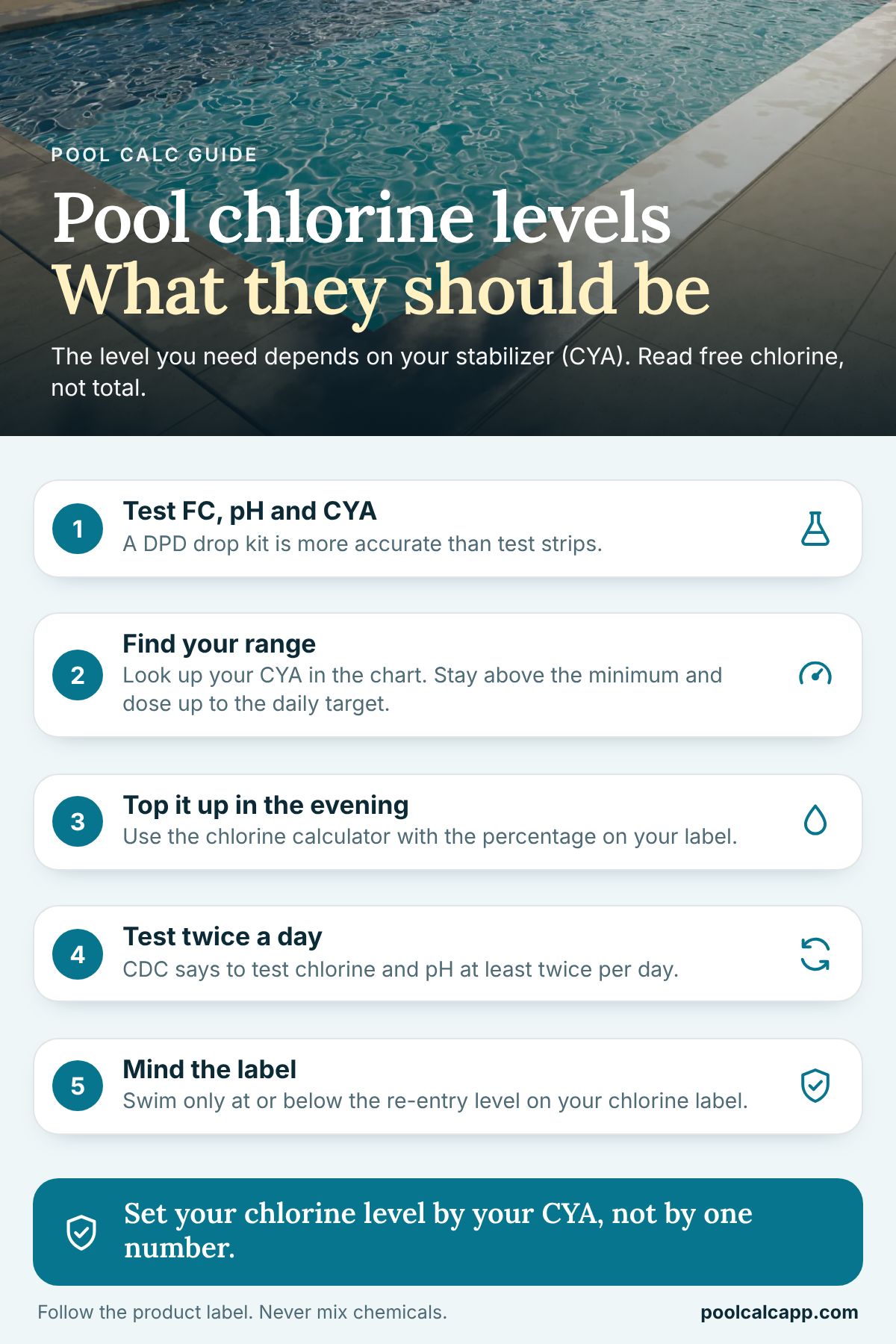
The quick answer: pool chlorine levels are measured as free chlorine (FC), and CDC recommends at least 1 ppm in pools, or at least 2 ppm if the pool uses stabilizer (cyanuric acid, CYA). In an outdoor pool the right level depends on your CYA: at CYA 40, keep free chlorine at or above 3 ppm and dose up to a daily target of about 6 ppm. Follow the product label for every chemical you add.
Chlorine calculator
Add
0.6gal
of Liquid chlorine 10%
77 fl oz2.3 L
Raises free chlorine from 2 ppm to 6 ppm in 15,000 gal. Best added at dusk.
- Side effects: Salt +6.6 ppm.
- Pour it slowly in front of a return jet with the pump running.
Check the product label. Strengths vary by brand, so enter the % printed on yours. Add one chemical at a time, into the water, and never mix chemicals.
With CYA at 40 ppm: minimum free chlorine 3 ppm, target 6 ppm, shock level 16 ppm. FC/CYA chart
Save this test and get reminded when it is time to retest.
Want this every time you test?
Pool Calc remembers your pool and tells you what to add next time.
Pool Calc for iPhone
Pool chlorine levels chart
These numbers come from the same chemistry engine as Pool Calc. The minimum is the level never to fall below, the target is where to dose up to, and the top of the range is where to stop. For the full table, every CYA level and the shock levels, see the FC/CYA chart.
| Stabilizer (CYA) | Minimum FC | Daily target | Top of range |
|---|---|---|---|
| 30 ppm | 2.3 | 5.3 | 7.3 |
| 40 ppm | 3 | 6 | 8 |
| 50 ppm | 3.8 | 6.8 | 8.8 |
| 70 ppm, salt water pool | 3.5 | 5.3 | 7.3 |
| 80 ppm, salt water pool | 4 | 6 | 8 |
All values are ppm free chlorine. Salt water pools run lower because the cell adds chlorine all day instead of in one dose.
Why there is no single "right" chlorine level
You will often see "1 to 3 ppm" given as the pool chlorine level. That works for a pool with no stabilizer, such as an indoor pool. Outdoors, almost every pool uses CYA to keep the sun from burning chlorine off, and CYA holds most of the free chlorine in reserve. TroubleFreePool's Pool School puts it simply: the level of free chlorine you need depends on your CYA level and how much you use the pool, and the higher the CYA, the more free chlorine you need for the same effect.
So 3 ppm can be plenty in one pool and too little in the next. That's why the chart above is set by CYA. If you don't know your CYA yet, test it first; what is CYA in a pool explains the reading.
Two more numbers set the edges:
- The label's re-entry level. Chlorine labels set when it's safe to swim. One EPA-registered liquid chlorine label, for example, says not to reenter the pool with a chlorine level above 4 ppm. Your own label decides.
- The upper limit. Pool Calc treats 10 ppm as the ceiling for swimming. CDC also notes that above 10 ppm a DPD test can bleach out and read falsely low or zero.
How to check and adjust your pool chlorine level
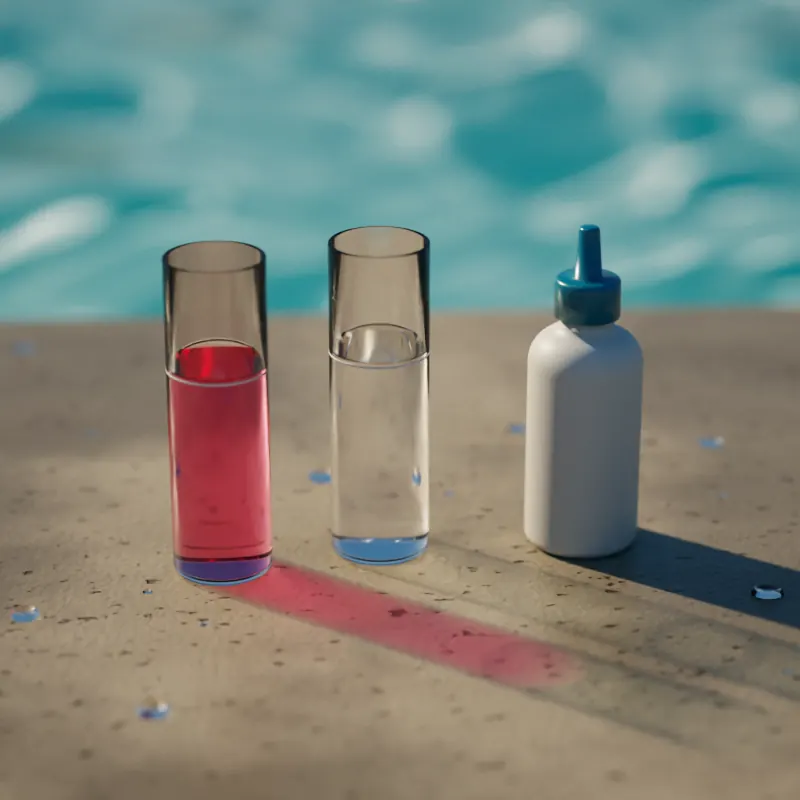
Step 1: Test free chlorine, pH and CYA. CDC recommends a DPD test kit for the most accurate results and notes that test strips are less accurate. Read free chlorine, not total; free chlorine vs total chlorine explains the difference. Test pH too: CDC recommends keeping it at 7.0 to 7.8. How to read pool test strips covers the timing and when to check a strip with drops.
Step 2: Find your range. Look up your CYA in the chart. Your free chlorine should never be below the minimum, even just before the next dose.
Step 3: Top it up if it's low. Dose up to the daily target, ideally in the evening so the sun doesn't take it before the water has mixed. For example, raising free chlorine from 3 to 6 ppm in a 10,000-gallon pool takes about 0.3 gal (1.1 L) of 10% liquid chlorine. US household bleach is sold at 6–8.25%, so use the chlorine calculator with the percentage on your own label instead of copying this example. Follow the product label, and add chlorine to the water with the pump running.
Step 4: Retest and keep a log. CDC says to test chlorine and pH at least twice per day, and more often when a number of people are using the pool. TroubleFreePool notes that outdoor pools naturally lose 2–4 ppm of free chlorine a day, so the target is a cushion, not a finish line. Log each reading in Pool Calc for iPhone so you can see how much your pool uses from one day to the next.
Pool chlorine level too low
Below the minimum for your CYA, chlorine can fall behind. TroubleFreePool's Pool School says that when free chlorine drops too low or goes to zero, algae and germs can grow. Top it up to the target today. If it falls back fast day after day, pool chlorine keeps dropping walks through the usual causes, and how much liquid chlorine to add has more dose examples.
Pool chlorine level too high
Above the top of your range, or above the re-entry level on your label, stop adding chlorine and let it come down. Sunlight and use bring it down on their own; pool chlorine too high covers how long that takes and what speeds it up.
When can you swim? Swim when free chlorine is back within your normal range and at or below the re-entry level on your chlorine label (many labels say 4 ppm). Never swim during a SLAM or with free chlorine above 10 ppm. Your product label always comes first.
Common mistakes
- Using one number for every pool. A level that suits an indoor pool with no CYA can be too low for an outdoor pool with CYA 50. Use the row for your CYA.
- Reading total chlorine instead of free chlorine. Total includes combined chlorine, which doesn't count toward your level.
- Testing once a week. Chlorine changes every day. Pool Calc keeps every test and dose in one log, so a slow slide is easy to spot.
- Guessing bleach strength. Household bleach varies from 6 to 8.25%. Dose with the percentage on your label.
Track it in Pool Calc
Pool Calc works out the chlorine range for your CYA, sizes each top-up for the product you use, and keeps a log of your readings. Get Pool Calc for iPhone and log your next test.
Sources
- CDC: Home Pool and Hot Tub Water Treatment and Testing: at least 1 ppm chlorine in pools, at least 2 ppm with cyanuric acid; pH 7.0–7.8; test chlorine and pH at least twice per day; DPD kits are more accurate than test strips; above 10 ppm a DPD test can bleach out.
- TroubleFreePool Pool School: Free Chlorine: the free chlorine you need depends on CYA and use; outdoor pools lose 2–4 ppm a day; algae and germs grow when free chlorine drops too low.
- TroubleFreePool Pool School: ABC's of Pool Water Chemistry: the higher the CYA, the more free chlorine you need for the same effect.
- EPA: sodium hypochlorite solution 12.5% label (PPLS): do not reenter the pool with a chlorine level above 4 ppm.
- Every level and dose on this page comes from the same chemistry engine as Pool Calc.
Safety
- Keep chemicals out of reach of children and pets, and keep them out of the water until it is back in range.
- Never mix chemicals. Never add acid and chlorine together: mixing them releases toxic chlorine gas.
- Add chemicals to water, never water to chemicals.
- Store chemicals sealed, cool and dry, apart from each other.
- Read and follow the product label. It always comes first.